Circles: 동영상 및 연습문제
Circles are measured using the radius, diameter, and circumference. The radius is the distance from the center to the edge, and the diameter goes across the circle through the center, so \(d=2r\) . The circumference is the distance around the circle and can be found with \(C=\pi d\) or \(C=2\pi r\) . The constant \(\pi\) is the ratio of circumference to diameter and is often approximated by \(3.14\) or \(\frac{22}{7}\).
The area of a circle measures the space inside it and is found with \(A=\pi r^2\) . This formula can be understood by rearranging circle wedges into a shape like a parallelogram with base \(\pi r\) and height \(r\). To find area, the radius must be known, so a given diameter is first divided by 2. Composite figures may include full circles, half circles, or regions found by adding or subtracting circle areas, and area is expressed in square units.
Circumference of a Circle


What is the radius of the following circle?
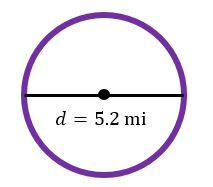
Find the circumference. Use .
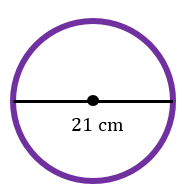
Find the circumference. Use .
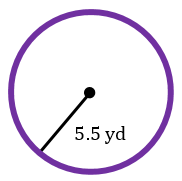
yd
yd
yd
yd
Circumference of a Circle Example 1
Area of a Circle
Find the area of the circle. Use and simplify.
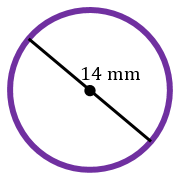
Find the area of the circle. Use and simplify.
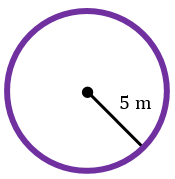
m2
m2
m2
m2
Area of a Circle Example 2
Area of a Circle Example 3
학생들이 이 주제에 대해 묻는 질문은 다음과 같습니다:
The radius of a circle is the distance from its center to any point on the edge, while the diameter is the distance across the circle passing through the center. The diameter is always twice the length of the radius. Mathematically, this relationship is expressed as , where is the diameter and is the radius. This means if you know the radius, you can find the diameter by doubling it, and vice versa. Understanding this relationship is fundamental when calculating other properties of circles, such as circumference and area.
The circumference of a circle is the distance around its edge. It can be calculated using either the diameter or the radius. The formulas are or , where is the circumference, is the diameter, is the radius, and (pi) is approximately 3.14159. If you know the diameter, multiply it by pi to get the circumference. If you know the radius, multiply it by 2 and then by pi. Pi can be approximated as 3.14 or as the fraction for easier calculations.
The area of a circle is given by because of how the circle can be divided and rearranged. If you cut a circle into many small wedges and arrange them alternately side by side, they form a shape resembling a parallelogram. The base of this parallelogram is half the circumference, which is , and the height is the radius . The area of a parallelogram is base times height, so the area becomes . This geometric reasoning explains why the formula for the area of a circle involves squaring the radius and multiplying by pi.
Pi (π) is an irrational number approximately equal to 3.14159265..., which means it has an infinite number of non-repeating decimals. Because of this, we often use approximations for practical calculations. The two common approximations are the decimal 3.14 and the fraction . Using 3.14 is straightforward for decimal calculations, while is useful for fraction-based calculations. These approximations make it easier to compute the circumference or area of circles without needing a calculator that can handle the exact value of π.
If you know the diameter of a circle, you can find the radius by dividing the diameter by 2: . Then, use the area formula . Substitute the radius into the formula to get , which simplifies to . This formula allows you to calculate the area directly from the diameter without first finding the radius explicitly.