Plurality With Elimination Method: 동영상 및 연습문제
The Plurality With Elimination Method is an election method that uses voters’ ranked ballots to find a winner. First, count only the first ranked votes. If any candidate has a majority, that candidate wins immediately. A majority means receiving more than half of all ballots, written as \(>50\\%\)
If no candidate has a majority of the first ranked votes, eliminate the candidate with the fewest first ranked votes. Then transfer those ballots according to the next available ranking and count the first ranked votes again among the remaining candidates. This elimination process continues until one candidate earns a majority. To check the majority threshold, use the total number of ballots and compare each candidate’s first-place count to one-half of that total.
Plurality With Elimination Method


An election with three candidates (Camille, Eliza, & Teddy) will be determined by the plurality with elimination method. Who wins the election?
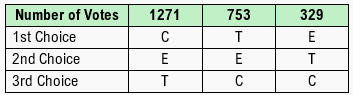
Camille
Eliza
Teddy
Plurality With Elimination Method Example 1
학생들이 이 주제에 대해 묻는 질문은 다음과 같습니다:
The Plurality With Elimination Method is an election system that uses ranked ballots to determine a winner. Voters rank candidates in order of preference. Initially, only the first-choice votes are counted. If a candidate receives a majority, meaning more than half of all ballots ( or 50%), that candidate wins immediately. If no candidate has a majority, the candidate with the fewest first-choice votes is eliminated. The ballots of the eliminated candidate are then transferred to the next preferred candidate on each ballot. This process of elimination and vote transfer continues until one candidate achieves a majority. This method ensures that the winner has broad support, not just a simple plurality, making it a more representative voting system.
In the Plurality With Elimination Method, the majority threshold is calculated based on the total number of ballots cast. A candidate must receive more than half of the total ballots to win. Mathematically, the majority threshold is of the total ballots. For example, if there are 100 ballots, a candidate needs more than 50 votes to have a majority. This threshold is checked after each round of counting. If no candidate reaches this majority, the candidate with the fewest votes is eliminated, and their votes are redistributed according to the next preferences on those ballots. This process repeats until a candidate surpasses the majority threshold.
When a candidate is eliminated in the Plurality With Elimination Method, their votes are not discarded. Instead, the ballots that ranked the eliminated candidate first are transferred to the next preferred candidate listed on each ballot. This means the votes are reallocated based on voters' subsequent choices. The process ensures that votes continue to count toward remaining candidates, reflecting voters' preferences beyond their first choice. This transfer continues each round after eliminating the candidate with the fewest votes until a candidate achieves a majority. This method helps to find a winner with broader support among voters.
The Plurality With Elimination Method is considered more representative because it requires a candidate to secure a majority of votes rather than just a simple plurality. In simple plurality voting, a candidate can win with less than 50% of the votes if they have more votes than any other candidate, which may not reflect the preference of most voters. The elimination method redistributes votes from the least popular candidates to others based on voter rankings, ensuring the winner has broader support. This reduces the chance of a candidate winning despite being opposed by a majority, making the election outcome more reflective of the electorate's overall preferences.
The elimination process in the Plurality With Elimination Method continues in rounds. After counting first-choice votes, if no candidate has a majority, the candidate with the fewest votes is eliminated. The ballots for that candidate are then transferred to the next preferred candidate on each ballot. Votes are recounted among the remaining candidates. This cycle of elimination and vote transfer repeats until one candidate obtains a majority, meaning more than half of the total ballots. This iterative process ensures that the final winner has majority support, even if it takes multiple rounds of elimination and redistribution to reach that outcome.