Hamilton's Method: 동영상 및 연습문제
Hamilton’s Method is an apportionment procedure for dividing a fixed number of items fairly among groups based on population size. The process begins with the standard divisor, found by \( \frac{\text{total population}}{\text{number of items}} \) . Then each group’s standard quota is calculated by dividing that group’s population by the standard divisor.
Next, find each group’s lower quota by rounding its standard quota down, which removes any decimal part. Add the lower quotas to see how many items have already been assigned, then compare that total to the number of items available to determine any leftovers. The remaining items are assigned one at a time to the groups with the largest decimal parts in their standard quotas.
This method helps students connect proportional fairness with whole-number distribution. In Hamilton’s Method, the final apportionment comes from combining the lower quotas with the leftover assignments, making the decimal parts of the standard quotas the key to deciding which groups receive the extra items.
Hamilton's Method


A workplace has three divisions led by Angelica, Eliza, and Peggy. They want to distribute 20 new ergonomic office chairs fairly across the three divisions, based on the size of each. Use Hamilton’s Method to apportion the new chairs.
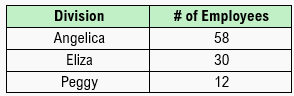
Angelica - 11; Eliza - 7; Peggy - 2
Angelica - 11; Eliza - 6; Peggy - 3
Angelica - 11; Eliza - 6; Peggy - 2
Angelica - 12; Eliza - 6; Peggy - 2
Hamilton's Method Example 1
학생들이 이 주제에 대해 묻는 질문은 다음과 같습니다:
Hamilton's Method is an apportionment procedure used to fairly distribute a fixed number of items, such as seats or resources, among groups based on their population sizes. The process starts by calculating the standard divisor, which is the total population divided by the number of items to be apportioned. Then, each group's standard quota is found by dividing its population by this standard divisor. The lower quota for each group is the standard quota rounded down to the nearest whole number. After assigning these lower quotas, the total assigned items are compared to the total available. Any leftover items are distributed one at a time to the groups with the largest decimal parts in their standard quotas. This method ensures proportional fairness while dealing with whole numbers, making it useful in political representation and resource allocation.
In Hamilton's Method, the standard divisor is a key value used to determine each group's share of the total items. It is calculated by dividing the total population by the total number of items to be apportioned. Mathematically, it is expressed as: . This divisor represents the average population per item and is used to calculate each group's standard quota by dividing the group's population by this divisor. The standard divisor helps translate population sizes into proportional shares for fair distribution.
The standard quota in Hamilton's Method is the exact proportional share of items a group should receive based on its population. It is calculated by dividing the group's population by the standard divisor. This value often includes a decimal part. The lower quota is the standard quota rounded down to the nearest whole number, effectively removing the decimal part. The lower quota represents the minimum guaranteed number of items assigned to the group initially. Leftover items, if any, are then distributed based on the size of the decimal parts of the standard quotas. This distinction ensures that the apportionment starts with whole numbers and then fairly allocates remaining items.
After calculating each group's lower quota in Hamilton's Method, the total assigned items may be less than the total available, resulting in leftover items. These leftover items are assigned one at a time to the groups with the largest decimal parts in their standard quotas. The decimal part is the fractional remainder after subtracting the lower quota from the standard quota. Groups with larger decimal parts are considered to have a stronger claim to an additional item. This process continues until all leftover items are distributed, ensuring a fair and proportional allocation that respects the original population ratios.
Hamilton's Method offers a straightforward and intuitive way to allocate items proportionally based on population, ensuring that groups receive at least their lower quota and that leftover items are fairly distributed. It connects proportional fairness with whole-number assignments, making it easy to understand and apply. However, the method has limitations, such as the possibility of the Alabama Paradox, where increasing the total number of items can cause a group to lose an item. It may also violate quota conditions in some cases. Despite these issues, Hamilton's Method remains a foundational approach in apportionment theory and is useful for educational purposes and certain practical applications.