Intro to Fractals: 동영상 및 연습문제
Intro to Fractals focuses on figures created by recursion: start with a figure, apply the same rule repeatedly, and continue the process infinitely many times. This is the basis of fractal geometry, which is used to describe repetitive patterns that basic Euclidean shapes do not capture well. A central idea is that a fractal is defined by a starting figure and a repeated rule, often producing smaller and smaller copies or modifications of the same structure.
A key property of fractals is self-similarity, meaning smaller pieces of the figure resemble the whole fractal. The Sierpinski triangle shows this by repeatedly removing the center triangle from each equilateral triangle, while the Koch snowflake grows by adding smaller equilateral triangles to exposed sides. Fractals are understood as the result of applying the rule infinitely many times, even though only early steps can be drawn by hand. As this process continues, a fractal may become visually stable, where changes between steps are too small to notice, while still keeping remarkable properties such as detailed structure at every scale.
Intro to Fractals


Determine if the following figure has self-similarity.
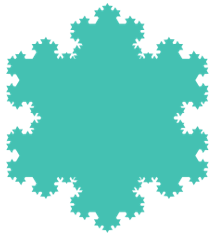
Yes; the figure has self-similarity.
No; the figure lacks self-similarity.
Cannot be determined
Determine if the following figure has self-similarity.
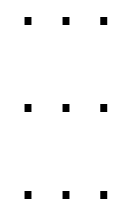
Yes; the figure has self-similarity.
No; the figure lacks self-similarity.
Cannot be determined
Intro to Fractals Example 1
Intro to Fractals Example 2
Intro to Fractals Example 3
학생들이 이 주제에 대해 묻는 질문은 다음과 같습니다:
A fractal is a complex geometric figure created by applying a simple rule repeatedly through a process called recursion. Unlike traditional Euclidean shapes such as squares or triangles, fractals exhibit intricate patterns that repeat at every scale. This property is called self-similarity, meaning smaller parts of the fractal resemble the whole figure. Traditional geometry deals with basic shapes and their dimensions, but fractal geometry describes natural and mathematical objects that have infinitely detailed structure, like the Sierpinski triangle or Romanesco broccoli. Fractals are generated by starting with an initial shape and applying the same transformation rule infinitely many times, resulting in patterns that cannot be captured by classical geometry.
The Sierpinski triangle is a classic example of recursion in fractals. It starts with an equilateral triangle, and the rule is to remove the center triangle formed by connecting the midpoints of each side. After the first step, three smaller equilateral triangles remain. The same rule is then applied to each of these smaller triangles, removing their centers, and this process repeats infinitely. Each iteration produces smaller triangles that look like the original, demonstrating self-similarity. This recursive process creates a fractal pattern where the structure repeats at every scale, and the figure becomes visually stable after many iterations, meaning further steps produce changes too small to notice.
Visual stability in fractals means that after applying the recursive rule many times, the changes between successive steps become so small that they are no longer noticeable to the human eye. Although the fractal is defined by infinitely many iterations, in practice, after a certain number of steps, the fractal appears to have reached its final form. For example, the Sierpinski triangle becomes visually stable after many iterations of removing center triangles. Even if you zoom in with a powerful microscope, the differences between further iterations are imperceptible. This concept helps us understand fractals as infinite processes that produce finite, stable visual patterns.
Self-similarity is a key property of fractals where smaller parts of the figure resemble the entire fractal. This means that if you zoom in on any section of the fractal, you will see a pattern similar to the whole. This property arises because fractals are generated by applying the same rule repeatedly to smaller and smaller parts of the figure. Self-similarity is important because it distinguishes fractals from traditional geometric shapes and explains why fractals can model complex natural phenomena like coastlines, clouds, and plants. It also allows fractals to have infinite detail and complexity despite being created from simple recursive rules.
Fractal geometry provides tools to describe complex, irregular, and infinitely detailed patterns found in nature that Euclidean geometry cannot capture. Traditional Euclidean shapes like squares, circles, and triangles are limited to smooth, regular forms. However, many natural objects, such as Romanesco broccoli, coastlines, and snowflakes, exhibit repetitive patterns at different scales. Fractal geometry uses recursive rules to model these self-similar structures, allowing us to mathematically represent their complexity. This approach helps in fields like biology, physics, and computer graphics by providing a framework to analyze and simulate natural forms more accurately than classical geometry.