Jefferson's Method: 동영상 및 연습문제
Jefferson’s Method is an apportionment process used to distribute a fixed number of items fairly among groups based on their populations. It begins with the standard divisor, found by dividing total population by the number of items to apportion: \(D=\frac{\text{total population}}{\text{number of items}}\) .
Next, choose a modified divisor that is lower than the standard divisor, then compute each group’s modified quota by dividing its population by that modified divisor. In Jefferson’s Method, each quota is rounded down to get the modified lower quota. The rounded values are added and checked against the total number of items. If the total is not correct, adjust the modified divisor and repeat until all items are apportioned exactly. This method emphasizes systematic adjustment and always rounds down after using the modified divisor.
Jefferson's Method


Jefferson's Method Example 1
A city has a youth association with three programs for different age groups: Child (0-6), Tween (7-12), and Teen (13-18). They want to apportion the 30 new volunteers fairly based on the number of youths served by each of these programs. Use Jefferson’s Method to get a fair apportionment.
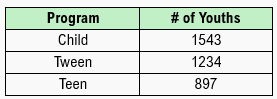
Child - 13; Tween - 10; Teen - 7
Child - 12; Tween - 10; Teen - 7
Child - 12; Tween - 11; Teen - 7
Child - 12; Tween - 10; Teen - 8
학생들이 이 주제에 대해 묻는 질문은 다음과 같습니다:
Jefferson's Method is an apportionment technique used to fairly distribute a fixed number of items, such as seats or resources, among groups based on their populations. The process starts by calculating the standard divisor, which is the total population divided by the number of items to be apportioned. This is represented as . Then, a modified divisor lower than the standard divisor is chosen. Each group's population is divided by this modified divisor to get a modified quota. Jefferson's Method always rounds these quotas down to the nearest whole number, called the modified lower quota. The sum of these rounded quotas is checked against the total number of items. If the sum is not equal to the total, the modified divisor is adjusted and the process repeats until the total number of items is exactly apportioned. This method ensures systematic adjustment and favors rounding down quotas.
In Jefferson's Method, the modified divisor is initially chosen to be less than the standard divisor, which is the total population divided by the number of items to apportion. The exact value of the modified divisor is not fixed at the start; instead, it is adjusted iteratively. You begin with a guess lower than the standard divisor and calculate each group's modified quota by dividing their population by this divisor. After rounding down each quota and summing them, if the total is less than the number of items, the modified divisor is decreased further to increase quotas. If the total is more, the divisor is increased. This trial-and-error adjustment continues until the sum of the rounded quotas equals the total number of items. This iterative approach ensures a fair and exact apportionment.
Jefferson's Method always rounds down quotas to maintain consistency and avoid over-allocation of items. By rounding down, each group's initial allocation is conservative, ensuring the total number of items assigned does not exceed the fixed total. Since the modified divisor is adjusted iteratively, rounding down helps control the sum of quotas, allowing the method to fine-tune the divisor until the total number of items is exactly apportioned. This approach contrasts with other methods that might round to the nearest whole number or round up, which can lead to over- or under-allocation. Jefferson's method's systematic rounding down combined with divisor adjustment ensures fairness and exactness in distribution.
Jefferson's Method offers several advantages. It guarantees that the total number of items is apportioned exactly by adjusting the divisor and rounding down quotas. This method tends to favor larger groups because rounding down reduces smaller groups' quotas more significantly, which can be seen as an advantage or disadvantage depending on context. It is systematic and straightforward to implement with iterative divisor adjustments. However, a disadvantage is that it can violate the quota rule, meaning some groups may receive fewer items than their exact proportional share. This can lead to perceived unfairness, especially for smaller groups. Despite this, Jefferson's Method remains historically significant and useful in certain apportionment scenarios.
Jefferson's Method differs primarily in how it rounds quotas and adjusts the divisor. Jefferson's Method always rounds quotas down after dividing populations by a modified divisor less than the standard divisor. In contrast, Hamilton's Method uses the standard divisor and assigns each group its lower quota, then distributes remaining items based on the largest fractional parts, which can lead to paradoxes. Webster's Method rounds quotas to the nearest whole number using a modified divisor adjusted iteratively. Jefferson's method tends to favor larger groups due to rounding down, while Webster's is more balanced, and Hamilton's can be more precise but less stable. Each method has trade-offs in fairness and complexity.