Similar Figures: 동영상 및 연습문제
Similar Figures have the same shape even if one is a larger or smaller version of the other. Two figures are similar when their corresponding angles have equal measure and their corresponding sides are proportional. For triangles, matching vertices must be written in the same order in a similarity statement, using the symbol \(\triangle ABC \sim \triangle XYZ\) .
To work with similar figures, first identify which angles and sides correspond. Then set up equal ratios using side lengths from one figure all in the numerator and side lengths from the other all in the denominator, such as \(\frac{AB}{XY}=\frac{BC}{YZ}=\frac{AC}{XZ}\) . These proportions can be solved with cross products to find missing side lengths.
Similar triangles also allow you to determine missing angle measures because corresponding angles are equal. In some cases, angle relationships such as supplementary angles or the triangle angle sum help identify one angle, and similarity transfers that measure to its matching angle in the other triangle.
Similar Triangles


Similar Triangles Example 1
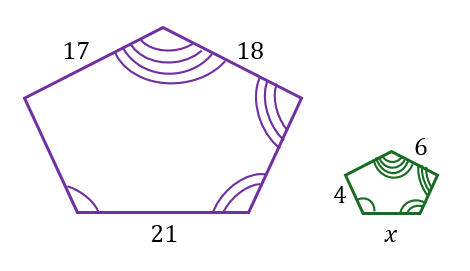
The following shapes are similar. Find .
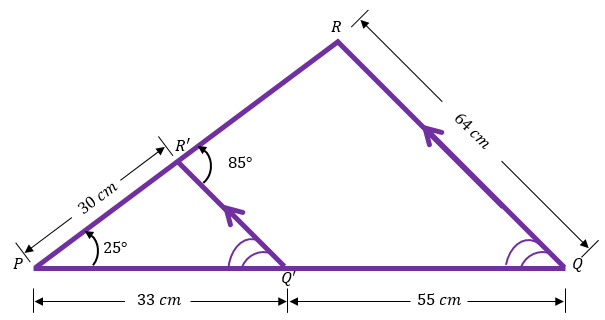
Use the similar triangles to find the following:
(A)
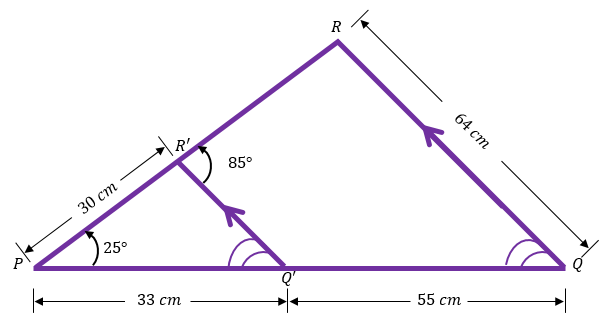
Use the similar triangles to find the following:
(B) The length of
cm
cm
cm
cm
Similar Triangles Example 2
학생들이 이 주제에 대해 묻는 질문은 다음과 같습니다:
Two figures are similar if they satisfy two main conditions. First, their corresponding angles must have equal measures. This means that each angle in one figure matches an angle in the other figure with the same degree measure. Second, their corresponding sides must be proportional. This means the ratios of the lengths of corresponding sides are equal. For example, if one side in the first figure is twice as long as the corresponding side in the second figure, then all corresponding sides must have that same ratio. These conditions ensure that the figures have the same shape but may differ in size.
When writing a similarity statement for two triangles, you use the symbol to indicate similarity. The order of the vertices in the statement is crucial because it shows which angles correspond. For example, if is similar to , then vertex A corresponds to X, B corresponds to Y, and C corresponds to Z. The statement must maintain this order to correctly represent the matching angles and sides. Writing would be incorrect because the corresponding vertices would not align properly.
To find missing side lengths in similar triangles, you set up proportions using the lengths of corresponding sides. First, identify pairs of corresponding sides from each triangle. Then, create ratios where all known side lengths from one triangle are in the numerator and the corresponding side lengths from the other triangle are in the denominator. For example, if sides and correspond, you write . Set up at least two such ratios, one including the unknown side length. Solve the resulting equation using cross multiplication to find the missing length.
Maintaining the order of vertices in similarity statements is important because it ensures that corresponding angles and sides are correctly matched. Each vertex in the first triangle corresponds to a specific vertex in the second triangle, and this correspondence dictates which sides and angles are related. If the order is changed, the statement may imply incorrect pairings, leading to errors in solving problems involving similarity. For example, means angle A corresponds to X, B to Y, and C to Z. Reversing the order would misrepresent these relationships.
Corresponding angles and sides are key to determining triangle similarity. Two triangles are similar if all their corresponding angles are equal in measure, which guarantees the same shape. Additionally, their corresponding sides must be proportional, meaning the ratios of the lengths of corresponding sides are equal. By verifying these two conditions, you confirm similarity. This allows you to use properties of similar triangles to solve for unknown sides or angles, making these relationships fundamental in geometry.