Ch. 12 - Radicals
Bruice - Organic Chemistry 8th Edition
Bruice8th EditionOrganic ChemistryISBN: 9780135213711당신이 사용하는 게 아니라요?교과서 변경
12장, 문제 37b

Which product would be obtained in greatest yield? Explain.

검증된 단계별 안내
1
Identify the type of reaction taking place (e.g., substitution, elimination, addition, etc.) and the reactants involved. This will help determine the possible products.
Analyze the reaction conditions (e.g., solvent, temperature, catalyst, etc.) to understand how they influence the reaction mechanism and the stability of the products.
Determine the stability of the possible products by considering factors such as resonance, hyperconjugation, steric hindrance, and electronic effects. The most stable product is typically formed in the greatest yield.
Apply the concept of regioselectivity or stereoselectivity, if relevant, to predict which product is favored. For example, in electrophilic addition reactions, Markovnikov's rule or anti-Markovnikov's rule may apply.
Conclude which product is obtained in the greatest yield based on the analysis of stability, reaction mechanism, and selectivity, and provide a clear explanation for your reasoning.

비슷한 문제에 대한 검증된 영상 답변:

이 영상 해법은 위 문제에 도움이 된다고 튜터들이 추천한 것입니다.
도움이 되었나요?

주요 개념

질문에 올바르게 답하기 위해 반드시 이해해야 하는 핵심 개념들은 다음과 같습니다.

Reaction Mechanism

Understanding the reaction mechanism is crucial for predicting the products of a chemical reaction. It involves the step-by-step process by which reactants are converted into products, including the formation and breaking of bonds. Knowledge of intermediates and transition states can help determine which product is favored under specific conditions.
추천 영상:
02:16
Heck Reaction Mechanism

Thermodynamics

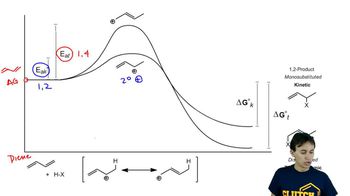
Thermodynamics plays a key role in determining the stability of products formed in a reaction. The Gibbs free energy change (ΔG) indicates whether a reaction is spontaneous and can help predict which product will be obtained in greater yield. A lower energy product is generally more stable and thus more likely to be formed in higher amounts.
추천 영상:
08:51
Kinetic vs. Thermodynamic Control

Kinetics

Kinetics refers to the rate of a chemical reaction and how it influences product formation. Factors such as temperature, concentration, and the presence of catalysts can affect the speed at which products are formed. Understanding the kinetics can help identify which product will be produced more quickly and in greater yield, especially in competitive reactions.
추천 영상:
08:51
Kinetic vs. Thermodynamic Control