Ch.11 - Reactions of Alcohols
Wade - Organic Chemistry 9th Edition
Wade9th EditionOrganic ChemistryISBN: 9780135213728당신이 사용하는 게 아니라요?교과서 변경
11장, 문제 1a,b,c

Classify each reaction as an oxidation, a reduction, or neither.
(a)
(b)
(c)

검증된 단계별 안내
1
Step 1: Analyze reaction (A). The starting material is a primary alcohol, which is oxidized using CrO3 in pyridine to form an aldehyde. The aldehyde is further oxidized using H2CrO4 to form a carboxylic acid. Since the oxidation state of the carbon increases, this reaction is classified as an oxidation.
Step 2: Analyze reaction (B). The starting material is an alkane, which is oxidized to a primary alcohol. The alcohol is further oxidized to an aldehyde and then to a carboxylic acid. Each step involves an increase in the oxidation state of the carbon, so this reaction is classified as an oxidation.
Step 3: Analyze reaction (C). The starting material is a diol (compound with two hydroxyl groups). One hydroxyl group is oxidized to a ketone, while the other hydroxyl group is removed as water. The formation of the ketone involves an increase in the oxidation state of the carbon, so this reaction is classified as an oxidation.
Step 4: Understand the concept of oxidation and reduction in organic chemistry. Oxidation involves an increase in the oxidation state of a carbon atom, typically through the addition of oxygen or removal of hydrogen. Reduction involves a decrease in the oxidation state, typically through the addition of hydrogen or removal of oxygen.
Step 5: Summarize the classifications. Reaction (A) is an oxidation, reaction (B) is an oxidation, and reaction (C) is an oxidation. None of the reactions are classified as reductions or neither.

비슷한 문제에 대한 검증된 영상 답변:

이 영상 해법은 위 문제에 도움이 된다고 튜터들이 추천한 것입니다.
영상 길이:
13m
도움이 되었나요?

주요 개념

질문에 올바르게 답하기 위해 반드시 이해해야 하는 핵심 개념들은 다음과 같습니다.

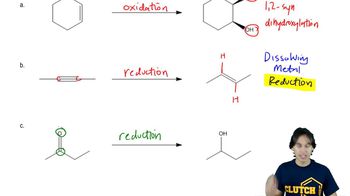
Oxidation and Reduction Reactions

In organic chemistry, oxidation refers to the loss of electrons or an increase in oxidation state, often involving the addition of oxygen or the removal of hydrogen. Conversely, reduction is the gain of electrons or a decrease in oxidation state, typically involving the addition of hydrogen or the removal of oxygen. Understanding these definitions is crucial for classifying reactions accurately.
추천 영상:
00:54
Distinguishing between Oxidation and Reduction

Chromic Acid Oxidation

Chromic acid (H2CrO4) is a strong oxidizing agent commonly used to oxidize alcohols to carbonyl compounds. In the presence of pyridine, it can convert primary alcohols to aldehydes and secondary alcohols to ketones. Recognizing the role of chromic acid in these transformations helps in identifying oxidation reactions in organic synthesis.
추천 영상:
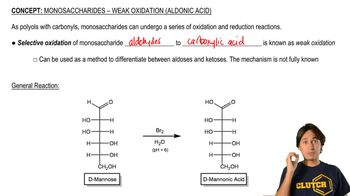
04:15
Monosaccharides - Weak Oxidation (Aldonic Acid)

Hydration and Dehydration Reactions

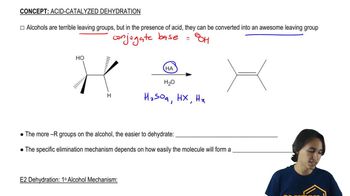
Hydration reactions involve the addition of water to a compound, while dehydration reactions involve the removal of water. In organic chemistry, these processes can lead to the formation of alcohols or the conversion of alcohols to alkenes. Understanding these concepts is essential for classifying reactions that involve the addition or removal of water, as seen in the provided reactions.
추천 영상:
06:01
General features of acid-catalyzed dehydration.