Ch.11 - Reactions of Alcohols
Wade - Organic Chemistry 9th Edition
Wade9th EditionOrganic ChemistryISBN: 9780135213728당신이 사용하는 게 아니라요?교과서 변경
11장, 문제 1d,e,f

Classify each reaction as an oxidation, a reduction, or neither.
(d)
(e)
(f)

검증된 단계별 안내
1
Step 1: Analyze the first reaction. The starting material is ethanol (CH₃CH₂OH), which is reduced to ethane (CH₃CH₃) using LiAlH₄/TiCl₄. Reduction involves the gain of hydrogen or the loss of oxygen. Here, the hydroxyl group (-OH) is removed, and the molecule gains hydrogen atoms, classifying this reaction as a reduction.
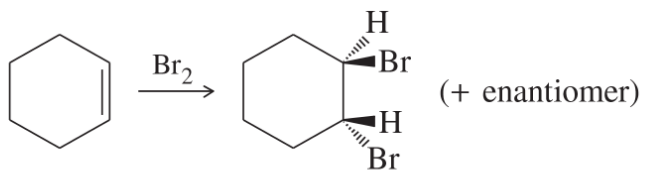
Step 2: Examine the second reaction. The starting material is cyclohexene, which reacts with bromine (Br₂) to form a dibromocyclohexane product with two bromine atoms added across the double bond. This is an addition reaction, but it does not involve a change in oxidation state (no gain or loss of hydrogen or oxygen). Therefore, this reaction is classified as neither oxidation nor reduction.
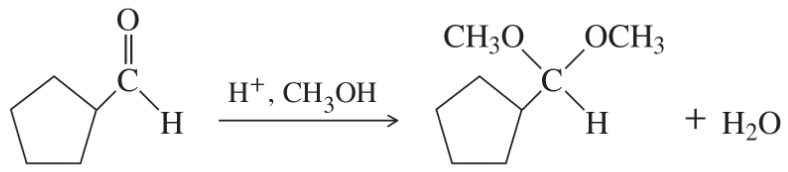
Step 3: Evaluate the third reaction. The starting material is cyclopentanone, which reacts with methanol (CH₃OH) under acidic conditions to form an acetal product. This reaction involves the formation of a new bond between the carbonyl carbon and the methanol molecules, but there is no change in oxidation state. Thus, this reaction is classified as neither oxidation nor reduction.
Step 4: Understand the concepts of oxidation and reduction in organic chemistry. Oxidation typically involves the loss of hydrogen or the gain of oxygen, while reduction involves the gain of hydrogen or the loss of oxygen. Reactions that do not involve these changes are classified as neither.
Step 5: Summarize the classifications: (d) Reduction, (e) Neither, (f) Neither.

비슷한 문제에 대한 검증된 영상 답변:

이 영상 해법은 위 문제에 도움이 된다고 튜터들이 추천한 것입니다.
영상 길이:
5m

주요 개념

질문에 올바르게 답하기 위해 반드시 이해해야 하는 핵심 개념들은 다음과 같습니다.

Oxidation and Reduction

Oxidation and reduction are fundamental concepts in organic chemistry that describe the transfer of electrons between species. Oxidation involves the loss of electrons or an increase in oxidation state, while reduction is the gain of electrons or a decrease in oxidation state. Understanding these processes is crucial for classifying reactions correctly.
추천 영상:
00:54
Distinguishing between Oxidation and Reduction

Reagents in Organic Reactions

Reagents such as lithium aluminum hydride (LiAlH4) and titanium tetrachloride (TiCl4) are commonly used in organic reactions to facilitate transformations. LiAlH4 is a strong reducing agent that can convert alcohols to alkanes by removing the hydroxyl group and replacing it with hydrogen. Recognizing the role of these reagents helps in predicting the outcome of the reaction.
추천 영상:
02:17
Identifying organic molecules

Functional Group Transformations

Functional group transformations involve changing one functional group into another during a chemical reaction. In the provided reaction, the hydroxyl group (-OH) of an alcohol is transformed into a hydrogen atom, resulting in the formation of an alkane. Understanding these transformations is essential for predicting the products of organic reactions.
추천 영상:
02:36
Identifying Functional Groups