Ch.11 - Reactions of Alcohols
Wade - Organic Chemistry 9th Edition
Wade9th EditionOrganic ChemistryISBN: 9780135213728당신이 사용하는 게 아니라요?교과서 변경
11장, 문제 1j,k,l

Classify each reaction as an oxidation, a reduction, or neither.
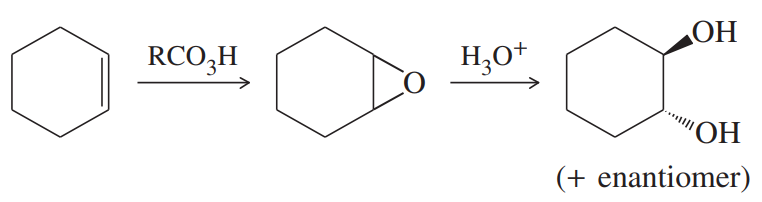
(j)
(k)
(l) Chemical reaction showing the conversion of a cyclohexene to cyclohexanol using BH3 and H2O2.

검증된 단계별 안내
1
Step 1: Analyze the first reaction (j). The starting material is cyclohexene, which undergoes reaction with a peroxyacid (RCO₃H) to form an epoxide. This is followed by hydrolysis with H₃O⁺ to produce a trans-diol. The formation of the epoxide involves the addition of oxygen, which is an oxidation process.
Step 2: Analyze the second reaction (k). Cyclohexene reacts with Cl₂ and H₂O to form a halohydrin. The addition of chlorine and hydroxyl groups does not involve a change in the oxidation state of the carbon atoms. Therefore, this reaction is classified as neither oxidation nor reduction.
Step 3: Analyze the third reaction (l). Cyclohexene undergoes hydroboration-oxidation using BH₃·THF followed by H₂O₂ and OH⁻ to form cyclohexanol. The addition of a hydroxyl group to the alkene involves the gain of hydrogen, which is a reduction process.
Step 4: Understand the definitions. Oxidation in organic chemistry typically involves the addition of oxygen or the removal of hydrogen, while reduction involves the addition of hydrogen or the removal of oxygen. Reactions that do not change the oxidation state are classified as neither.
Step 5: Summarize the classifications. Reaction (j) is an oxidation, reaction (k) is neither, and reaction (l) is a reduction.

비슷한 문제에 대한 검증된 영상 답변:

이 영상 해법은 위 문제에 도움이 된다고 튜터들이 추천한 것입니다.
영상 길이:
7m

주요 개념

질문에 올바르게 답하기 위해 반드시 이해해야 하는 핵심 개념들은 다음과 같습니다.

Oxidation and Reduction

Oxidation and reduction are chemical processes that involve the transfer of electrons between substances. Oxidation refers to the loss of electrons or an increase in oxidation state, while reduction involves the gain of electrons or a decrease in oxidation state. Understanding these concepts is crucial for classifying reactions accurately.
추천 영상:
00:54
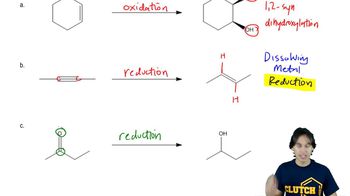
Distinguishing between Oxidation and Reduction

Oxidation States

Oxidation states (or oxidation numbers) are a way to keep track of electron transfer in chemical reactions. Each element in a compound is assigned an oxidation state based on its electron configuration and bonding. By analyzing the changes in oxidation states of elements in a reaction, one can determine whether the reaction is an oxidation, reduction, or neither.
추천 영상:
03:08
Ground vs. Excited States

Redox Reactions

Redox reactions, short for reduction-oxidation reactions, are processes where the oxidation state of one or more substances changes. These reactions are characterized by the simultaneous occurrence of oxidation and reduction. Identifying whether a reaction is a redox reaction is essential for classifying it correctly as either an oxidation or a reduction.
추천 영상:
06:02
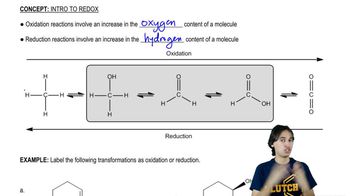
General Features of Redox