Ch.11 - Reactions of Alcohols
Wade - Organic Chemistry 9th Edition
Wade9th EditionOrganic ChemistryISBN: 9780135213728당신이 사용하는 게 아니라요?교과서 변경
11장, 문제 1g,h,i

Classify each reaction as an oxidation, a reduction, or neither.
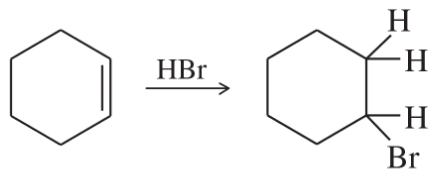
(g)
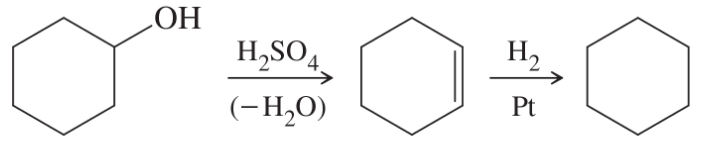
(h)
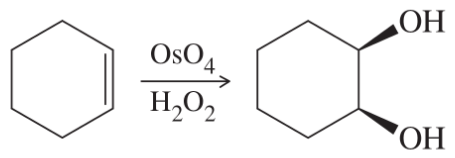
(i)

검증된 단계별 안내
1
Step 1: Analyze reaction (g). The reaction involves the addition of HBr to a cycloalkene. This is an electrophilic addition reaction where the double bond is broken, and a bromine atom is added to one carbon while a hydrogen atom is added to the other. Since there is no change in the oxidation state of the carbons involved, this reaction is classified as 'neither oxidation nor reduction.'
Step 2: Analyze reaction (h). The first step involves dehydration of the alcohol using H2SO4, resulting in the formation of a double bond (alkene). The second step involves hydrogenation of the alkene using H2 and Pt, converting the double bond into a single bond (alkane). The hydrogenation step adds hydrogen atoms to the molecule, reducing the alkene to an alkane. Therefore, this reaction is classified as a 'reduction.'
Step 3: Analyze reaction (i). The reaction involves the addition of OsO4 and H2O2 to a cycloalkene, resulting in the formation of a diol (two hydroxyl groups added to the molecule). This process increases the number of oxygen atoms in the molecule, which is characteristic of an oxidation reaction. Therefore, this reaction is classified as an 'oxidation.'
Step 4: Summarize the classifications: (g) is neither oxidation nor reduction, (h) is a reduction, and (i) is an oxidation.
Step 5: Ensure understanding by reviewing the definitions: Oxidation involves an increase in the number of bonds to oxygen or a decrease in bonds to hydrogen, while reduction involves an increase in bonds to hydrogen or a decrease in bonds to oxygen. Reactions that do not involve changes in oxidation states are classified as 'neither.'

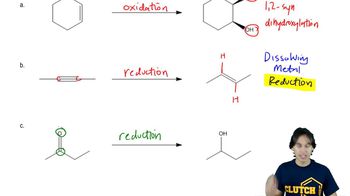
비슷한 문제에 대한 검증된 영상 답변:

이 영상 해법은 위 문제에 도움이 된다고 튜터들이 추천한 것입니다.
영상 길이:
7m
도움이 되었나요?

주요 개념

질문에 올바르게 답하기 위해 반드시 이해해야 하는 핵심 개념들은 다음과 같습니다.

Oxidation and Reduction

Oxidation refers to the loss of electrons or an increase in oxidation state, while reduction is the gain of electrons or a decrease in oxidation state. In organic chemistry, these processes often involve the addition or removal of oxygen or hydrogen atoms. Understanding these definitions is crucial for classifying reactions correctly.
추천 영상:
00:54
Distinguishing between Oxidation and Reduction

Electrophilic Addition Reactions

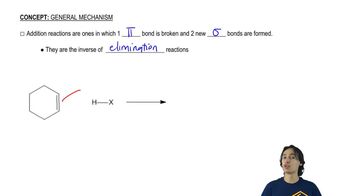
Electrophilic addition reactions occur when an electrophile reacts with a nucleophile, typically involving alkenes or alkynes. In the context of the provided reactions, the addition of HBr to an alkene in reaction A illustrates this concept, where the double bond is broken and new bonds are formed with the electrophile and nucleophile.
추천 영상:
05:39
Features of Addition Mechanisms.

Hydrogenation

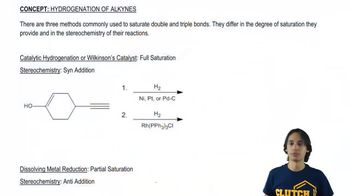
Hydrogenation is a specific type of reduction reaction where hydrogen (H2) is added to a compound, often in the presence of a catalyst like platinum (Pt). In reaction B, the conversion of an alkene to an alkane through hydrogenation exemplifies this process, highlighting the reduction of the carbon-carbon double bond.
추천 영상:
00:48
The definition of hydrogenation.