Ch.11 - Reactions of Alcohols
Wade - Organic Chemistry 9th Edition
Wade9th EditionOrganic ChemistryISBN: 9780135213728당신이 사용하는 게 아니라요?교과서 변경
11장, 문제 60

The Williamson ether synthesis involves the displacement of an alkyl halide or tosylate by an alkoxide ion. Would the synthesis shown be possible by making a tosylate and displacing it? If so, show the sequence of reactions. If not, explain why not and show an alternative synthesis that would be more likely to work.

검증된 단계별 안내
1
Step 1: Analyze the starting material and the product. The starting material is an alcohol (-OH group) attached to a bicyclic structure, and the product is an ether (-OCH₃ group) attached to the same bicyclic structure. The Williamson ether synthesis involves converting the alcohol into a good leaving group (e.g., tosylate) and then performing an SN2 reaction with an alkoxide ion.
Step 2: Consider the feasibility of the SN2 reaction. The bicyclic structure in the starting material is highly sterically hindered, which makes an SN2 reaction difficult. In an SN2 reaction, the nucleophile must approach the electrophilic carbon directly from the opposite side of the leaving group, but steric hindrance in this structure would block such an approach.
Step 3: Propose an alternative synthesis. Since the SN2 reaction is unlikely to succeed due to steric hindrance, an alternative method such as the use of an alkyl halide and silver oxide (Ag₂O) to form the ether might be more effective. This method avoids the steric hindrance issues associated with the SN2 mechanism.
Step 4: Outline the alternative synthesis. First, convert the alcohol into an alkyl halide using a reagent like thionyl chloride (SOCl₂) or phosphorus tribromide (PBr₃). Then, react the alkyl halide with methanol (CH₃OH) in the presence of silver oxide (Ag₂O) to form the desired ether.
Step 5: Summarize the reasoning. The tosylate approach is not feasible due to steric hindrance preventing the SN2 displacement. The alternative synthesis using an alkyl halide and silver oxide is more likely to succeed in forming the ether product.

비슷한 문제에 대한 검증된 영상 답변:

이 영상 해법은 위 문제에 도움이 된다고 튜터들이 추천한 것입니다.
영상 길이:
6m
도움이 되었나요?

주요 개념

질문에 올바르게 답하기 위해 반드시 이해해야 하는 핵심 개념들은 다음과 같습니다.

Williamson Ether Synthesis

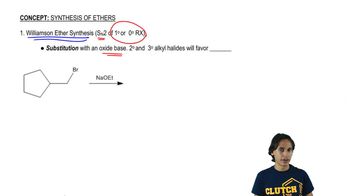
The Williamson ether synthesis is a method for creating ethers through the nucleophilic substitution of an alkyl halide or tosylate by an alkoxide ion. This reaction typically requires a strong nucleophile and is favored by primary alkyl halides to minimize steric hindrance, which can lead to elimination reactions instead of substitution.
추천 영상:
03:50
The Mechanism of Williamson Ether Synthesis.

Tosylate Formation

Tosylates are derivatives of alcohols formed by reacting an alcohol with tosyl chloride, making the alcohol a better leaving group. This transformation is crucial in the Williamson ether synthesis as it allows for the use of secondary or tertiary alcohols, which would otherwise be less reactive in nucleophilic substitution due to steric hindrance.
추천 영상:
02:26
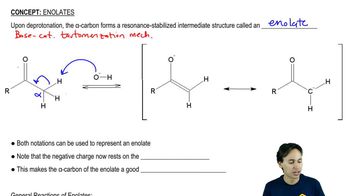
Formation of Enolates

Nucleophilic Substitution Mechanisms

Nucleophilic substitution can occur via two main mechanisms: SN1 and SN2. The SN2 mechanism involves a single concerted step where the nucleophile attacks the electrophile, displacing the leaving group. In contrast, the SN1 mechanism involves the formation of a carbocation intermediate, making it more favorable for tertiary substrates but less so for primary ones due to steric hindrance.
추천 영상:
01:47
Nucleophiles and Electrophiles can react in Substitution Reactions.
관련 실천
교과서 질문

Two unknowns, X and Y, both having the molecular formula C4H8O, give the following results with four chemical tests. Propose structures for X and Y consistent with this information.

1609
views

교과서 질문

Chromic acid oxidation of an alcohol (Section 11-2A) occurs in two steps: formation of the chromate ester, followed by an elimination of H+ and chromium. Which step do you expect to be rate-limiting? Careful kinetic studies have shown that Compound A undergoes chromic acid oxidation over 10 times as fast as Compound B. Explain this large difference in rates.

1113
views
교과서 질문

(b) Under the same conditions, an optically active sample of trans-2-bromocyclopentanol reacts with concentrated aqueous HBr to give an optically inactive product, (racemic) trans-1,2-dibromocyclopentane. Propose a mechanism to show how this reaction goes with apparently complete retention of configuration, yet with racemization. (Hint: Draw out the mechanism of the reaction of cyclopentene with Br2 in water to give the starting material, trans-2- bromocyclopentanol. Consider how parts of this mechanism might be involved in the reaction with HBr.)

1075
views
교과서 질문

(a) The reaction of butan-2-ol with concentrated aqueous HBr goes with partial racemization, giving more inversion than retention of configuration. Propose a mechanism that accounts for racemization with excess inversion.

1466
views
교과서 질문

Show how you would synthesize the following compound. As starting materials, you may use any alcohols containing five or fewer carbon atoms and any necessary solvents and inorganic reagents.

964
views
교과서 질문

The following pseudo-syntheses (guaranteed not to work) exemplify a common conceptual error.

(a) What is the conceptual error implicit in these syntheses?

(b) Propose syntheses that are more likely to succeed.

766
views