

Ch.9 - Alkynes
Wade - Organic Chemistry 9th Edition
Wade9th EditionOrganic ChemistryISBN: 9780135213728당신이 사용하는 게 아니라요?교과서 변경
9장, 문제 37d,e,f

Show how you would synthesize the following compounds, starting with acetylene and any compounds containing no more than four carbon atoms.
d. trans-hex-2-ene
e. 1,1-dibromohexane
f. 2,2-dibromohexane

검증된 단계별 안내
1
Step 1: For part (d), trans-hex-2-ene, start with acetylene (C₂H₂). Perform a double alkylation reaction using sodium amide (NaNH₂) to generate the acetylide ion, followed by reaction with ethyl bromide (C₂H₅Br) to form butyne (C₄H₆). Then, perform a partial catalytic hydrogenation using Lindlar's catalyst to selectively produce the cis-alkene. Finally, use a stereospecific isomerization reaction (e.g., with Na/NH₃) to convert the cis-alkene to the trans-alkene, yielding trans-hex-2-ene.
Step 2: For part (e), 1,1-dibromohexane, start with acetylene (C₂H₂). Perform a double alkylation reaction as in step 1 to form butyne (C₄H₆). Then, perform a hydroboration-oxidation reaction to convert the alkyne to hexan-1-ol. Finally, treat hexan-1-ol with phosphorus tribromide (PBr₃) to replace the hydroxyl group with bromine, and then react the resulting 1-bromohexane with bromine (Br₂) in the presence of light or heat to form 1,1-dibromohexane.
Step 3: For part (f), 2,2-dibromohexane, start with acetylene (C₂H₂). Perform a double alkylation reaction as in step 1 to form butyne (C₄H₆). Then, perform a hydroboration-oxidation reaction to convert the alkyne to hexan-2-ol. Treat hexan-2-ol with phosphorus tribromide (PBr₃) to replace the hydroxyl group with bromine, forming 2-bromohexane. Finally, react 2-bromohexane with bromine (Br₂) in the presence of light or heat to form 2,2-dibromohexane.
Step 4: Ensure that all reagents used in the synthesis are compatible with the reaction conditions and that the intermediates are purified as needed to avoid side reactions. For example, use distillation or recrystallization to isolate pure products after each step.
Step 5: Verify the structures of the final products (trans-hex-2-ene, 1,1-dibromohexane, and 2,2-dibromohexane) using spectroscopic techniques such as NMR and IR to confirm that the desired compounds have been synthesized successfully.

비슷한 문제에 대한 검증된 영상 답변:

이 영상 해법은 위 문제에 도움이 된다고 튜터들이 추천한 것입니다.
영상 길이:
13m

주요 개념

질문에 올바르게 답하기 위해 반드시 이해해야 하는 핵심 개념들은 다음과 같습니다.

Alkyne Reactivity

Acetylene, an alkyne, is a highly reactive compound that can undergo various reactions to form alkenes and alkanes. Understanding the reactivity of alkynes is crucial for synthesizing compounds like trans-hex-2-ene, as they can be converted to alkenes through hydrogenation or elimination reactions. The ability to manipulate the triple bond in acetylene allows for the construction of more complex carbon skeletons.
추천 영상:
09:11
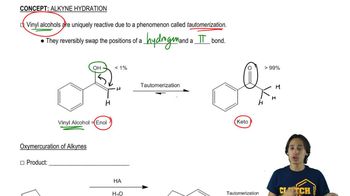
Alkyne Hydration

Stereochemistry

Stereochemistry refers to the spatial arrangement of atoms in molecules and is essential for understanding the properties of compounds like trans-hex-2-ene. The 'trans' configuration indicates that substituents are on opposite sides of the double bond, which affects the compound's physical properties and reactivity. Recognizing stereochemical configurations is vital for accurately synthesizing and characterizing organic compounds.
추천 영상:
가이드 코스
1:38
Polymer Stereochemistry Concept 1

Halogenation Reactions

Halogenation reactions involve the addition of halogens to alkenes or alkanes, which is key for synthesizing compounds like 1,1-dibromohexane and 2,2-dibromohexane. These reactions can be performed through electrophilic addition mechanisms, where halogens add across double bonds or to saturated hydrocarbons. Understanding these mechanisms is essential for controlling the outcome of the synthesis and achieving the desired halogenated products.
추천 영상:
03:45
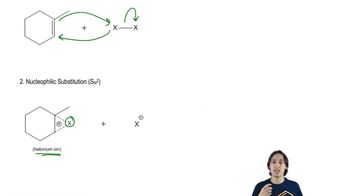
Halogenation Mechanism