Ch.9 - Alkynes
Wade - Organic Chemistry 9th Edition
Wade9th EditionOrganic ChemistryISBN: 9780135213728당신이 사용하는 게 아니라요?교과서 변경
9장, 문제 38

When treated with hydrogen and a platinum catalyst, an unknown compound X absorbs 5 equivalents of hydrogen to give n-butylcyclohexane. Treatment of X with an excess of ozone, followed by dimethyl sulfide and water, gives the following products:

Propose a structure for the unknown compound X. Is there any uncertainty in your structure?

검증된 단계별 안내
1
Step 1: Analyze the hydrogenation data. The unknown compound X absorbs 5 equivalents of hydrogen when treated with hydrogen and a platinum catalyst. This indicates that X contains five π-bonds, which could be double bonds or triple bonds.
Step 2: Examine the ozonolysis products. The products include formaldehyde (HCHO), glyoxal (OHC-CHO), malonic acid (HOOC-CH2-COOH), and oxalic acid (HOOC-COOH). These products suggest that X contains multiple double bonds arranged in a specific pattern.
Step 3: Deduce the structure of X based on the ozonolysis products. Ozonolysis cleaves double bonds to form carbonyl compounds. The presence of formaldehyde and glyoxal indicates terminal double bonds, while malonic acid and oxalic acid suggest internal double bonds.
Step 4: Propose a structure for X. Based on the hydrogenation and ozonolysis data, X is likely a polyunsaturated hydrocarbon with five double bonds arranged in a conjugated or isolated manner. The structure should account for the specific ozonolysis products.
Step 5: Address uncertainty in the structure. While the proposed structure fits the data, there may be alternative arrangements of double bonds that yield the same ozonolysis products. Further experimental data, such as NMR or IR spectroscopy, could confirm the exact structure of X.

비슷한 문제에 대한 검증된 영상 답변:

이 영상 해법은 위 문제에 도움이 된다고 튜터들이 추천한 것입니다.
영상 길이:
12m
도움이 되었나요?

주요 개념

질문에 올바르게 답하기 위해 반드시 이해해야 하는 핵심 개념들은 다음과 같습니다.

Hydrogenation

Hydrogenation is a chemical reaction that involves the addition of hydrogen (H2) to an unsaturated compound, typically in the presence of a catalyst such as platinum. This process converts alkenes or alkynes into alkanes by saturating the carbon-carbon double or triple bonds. In this question, the unknown compound X absorbs 5 equivalents of hydrogen, indicating it likely contains multiple unsaturated bonds that are being reduced.
추천 영상:
00:48
The definition of hydrogenation.

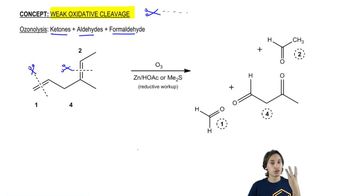
Ozonolysis

Ozonolysis is a reaction involving the cleavage of carbon-carbon double bonds using ozone (O3), followed by reduction with agents like dimethyl sulfide. This reaction typically results in the formation of carbonyl compounds, such as aldehydes or ketones. The products shown in the image suggest that ozonolysis was performed on compound X, leading to the formation of various carbonyl-containing products, which can help deduce the structure of X.
추천 영상:
06:30
General properties of ozonolysis.

Structural Isomerism

Structural isomerism occurs when compounds have the same molecular formula but different structural arrangements of atoms. In the context of the question, the uncertainty in the proposed structure for compound X may arise from the possibility of multiple structural isomers that could yield the same products upon hydrogenation and ozonolysis. Understanding the different isomeric forms is crucial for accurately identifying the unknown compound.
추천 영상:
06:47
Monosaccharides - D and L Isomerism