Ch.6 - Alkyl Halides; Nucleophilic Substitution
Wade - Organic Chemistry 9th Edition
Wade9th EditionOrganic ChemistryISBN: 9780135213728당신이 사용하는 게 아니라요?교과서 변경
6장, 문제 16a,b

For each pair, predict the stronger nucleophile in the SN2 reaction (using an alcohol as the solvent). Explain your prediction.
a. (CH3CH2)3N or (CH3CH2)2NH
b. (CH3)2O or (CH3)2S

검증된 단계별 안내
1
Step 1: Understand the concept of nucleophilicity in SN2 reactions. Nucleophilicity refers to the ability of a species to donate a pair of electrons to an electrophile. In SN2 reactions, nucleophilicity is influenced by factors such as charge, electronegativity, steric hindrance, and the solvent used.
Step 2: Analyze the solvent's role. Alcohol is a protic solvent, meaning it can form hydrogen bonds with nucleophiles. Protic solvents tend to stabilize charged nucleophiles through hydrogen bonding, which can reduce their nucleophilicity. Neutral nucleophiles are less affected by this stabilization.
Step 3: Compare the nucleophiles in part (a). (CH3CH2)3N is a tertiary amine, while (CH3CH2)2NH is a secondary amine. Tertiary amines are more sterically hindered, making it harder for them to approach the electrophile in an SN2 reaction. Secondary amines, with less steric hindrance, are typically stronger nucleophiles in SN2 reactions.
Step 4: Compare the nucleophiles in part (b). (CH3)2O is an ether, while (CH3)2S is a thioether. Sulfur is less electronegative than oxygen, meaning it holds onto its electrons less tightly and is more polarizable. This makes (CH3)2S a stronger nucleophile than (CH3)2O in an SN2 reaction, especially in a protic solvent like alcohol.
Step 5: Summarize the predictions. For part (a), (CH3CH2)2NH is the stronger nucleophile due to reduced steric hindrance. For part (b), (CH3)2S is the stronger nucleophile due to sulfur's lower electronegativity and higher polarizability compared to oxygen.

비슷한 문제에 대한 검증된 영상 답변:

이 영상 해법은 위 문제에 도움이 된다고 튜터들이 추천한 것입니다.
영상 길이:
3m
도움이 되었나요?

주요 개념

질문에 올바르게 답하기 위해 반드시 이해해야 하는 핵심 개념들은 다음과 같습니다.

Nucleophilicity

Nucleophilicity refers to the ability of a species to donate an electron pair to an electrophile during a chemical reaction. Stronger nucleophiles are typically negatively charged or have lone pairs that can be readily donated. Factors influencing nucleophilicity include charge, electronegativity, and steric hindrance, with less steric hindrance generally leading to stronger nucleophiles.
추천 영상:
08:27
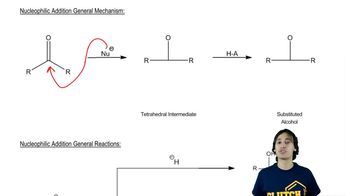
Nucleophilic Addition

SN2 Mechanism

The SN2 mechanism is a type of nucleophilic substitution reaction where the nucleophile attacks the electrophile from the opposite side of the leaving group, resulting in a concerted reaction. This mechanism is characterized by a single transition state and is sensitive to steric factors; less hindered substrates favor SN2 reactions, making the choice of nucleophile and solvent critical for predicting reaction outcomes.
추천 영상:
08:33
Drawing the SN2 Mechanism

Solvent Effects

The choice of solvent can significantly influence nucleophilicity and reaction rates in SN2 reactions. Protic solvents, like alcohols, can stabilize nucleophiles through hydrogen bonding, potentially reducing their reactivity. In contrast, aprotic solvents can enhance nucleophilicity by not stabilizing the nucleophile as much, thus affecting the overall reaction dynamics and the strength of the nucleophiles involved.
추천 영상:
01:16
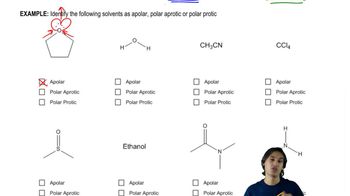
Identification of polarity in solvents