Ch.6 - Alkyl Halides; Nucleophilic Substitution
Wade - Organic Chemistry 9th Edition
Wade9th EditionOrganic ChemistryISBN: 9780135213728당신이 사용하는 게 아니라요?교과서 변경
6장, 문제 36

Give two syntheses for (CH3)2CH—O—CH2CH3, and explain which synthesis is better.

검증된 단계별 안내
1
Step 1: Analyze the target molecule (CH3)2CH—O—CH2CH3. It is an ether, which can be synthesized using the Williamson ether synthesis. This method involves reacting an alkoxide ion with a primary alkyl halide.
Step 2: First synthesis approach: Use isopropanol ((CH3)2CH—OH) to form the isopropoxide ion by deprotonating it with a strong base like NaH or K. Then react the isopropoxide ion with ethyl bromide (CH3CH2Br) to form the desired ether.
Step 3: Second synthesis approach: Use ethanol (CH3CH2—OH) to form the ethoxide ion by deprotonating it with a strong base like NaH or K. Then react the ethoxide ion with isopropyl bromide ((CH3)2CH—Br) to form the desired ether.
Step 4: Compare the two syntheses: The Williamson ether synthesis works best when the alkyl halide is primary because secondary and tertiary alkyl halides are prone to elimination reactions under basic conditions. Therefore, the first synthesis (using ethyl bromide as the alkyl halide) is better because ethyl bromide is a primary alkyl halide, minimizing side reactions.
Step 5: Conclude: The first synthesis is preferred due to the reduced likelihood of elimination reactions and higher yield of the desired ether. The second synthesis may lead to side reactions due to the secondary nature of isopropyl bromide.

비슷한 문제에 대한 검증된 영상 답변:

이 영상 해법은 위 문제에 도움이 된다고 튜터들이 추천한 것입니다.
영상 길이:
7m
도움이 되었나요?

주요 개념

질문에 올바르게 답하기 위해 반드시 이해해야 하는 핵심 개념들은 다음과 같습니다.

Nucleophilic Substitution Reactions

Nucleophilic substitution reactions involve the replacement of a leaving group in a molecule by a nucleophile. In the context of the question, the synthesis of (CH3)2CH—O—CH2CH3 can occur through either an SN1 or SN2 mechanism, depending on the structure of the reactants and the conditions. Understanding the nature of the nucleophile and the substrate is crucial for predicting the reaction pathway.
추천 영상:
01:47
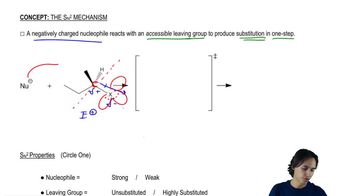
Nucleophiles and Electrophiles can react in Substitution Reactions.

SN2 Mechanism

The SN2 mechanism is a one-step nucleophilic substitution process where the nucleophile attacks the electrophile simultaneously as the leaving group departs. This mechanism is characterized by a backside attack, leading to inversion of configuration at the carbon center. It is favored in primary and some secondary substrates, making it a potential pathway for synthesizing (CH3)2CH—O—CH2CH3.
추천 영상:
08:33
Drawing the SN2 Mechanism

Reaction Conditions and Selectivity

The choice of reaction conditions, such as solvent, temperature, and concentration, significantly influences the outcome of nucleophilic substitution reactions. For example, polar aprotic solvents favor SN2 reactions by stabilizing the nucleophile without solvating it too much. Evaluating the conditions for each proposed synthesis will help determine which method is more efficient and yields a higher purity of the desired product.
추천 영상:
10:08
Radical selectivity:Alcoholics Anonymous Version