Ch.6 - Alkyl Halides; Nucleophilic Substitution
Wade - Organic Chemistry 9th Edition
Wade9th EditionOrganic ChemistryISBN: 9780135213728당신이 사용하는 게 아니라요?교과서 변경
6장, 문제 34a,b

Predict the compound in each pair that will undergo solvolysis (in aqueous ethanol) more rapidly.
(a) (CH3CH2)2CH—Cl or (CH3)3C—Cl
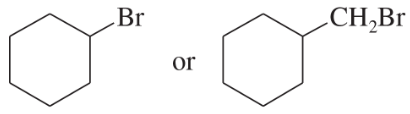
(b)

검증된 단계별 안내
1
Step 1: Understand the concept of solvolysis. Solvolysis is a nucleophilic substitution reaction where the solvent acts as the nucleophile. The rate of solvolysis depends on the stability of the carbocation intermediate formed during the reaction. Tertiary carbocations are more stable than secondary or primary carbocations due to hyperconjugation and inductive effects.
Step 2: Analyze part (a) of the problem. Compare (CH3CH2)2CH—Cl and (CH3)3C—Cl. The first compound has a secondary alkyl chloride, while the second compound has a tertiary alkyl chloride. Since tertiary carbocations are more stable, (CH3)3C—Cl will undergo solvolysis more rapidly.
Step 3: Analyze part (b) of the problem. Compare the two structures provided in the image. For the first pair in part B, the compound with the allylic bromide (Br attached to a carbon adjacent to a double bond) will undergo solvolysis more rapidly due to the resonance stabilization of the allylic carbocation. For the second pair, the compound with the tertiary bromide will undergo solvolysis more rapidly due to the stability of the tertiary carbocation.
Step 4: Consider the second image for part (b). Compare the linear alkyl chloride and the branched alkyl chloride. The branched alkyl chloride forms a secondary carbocation upon solvolysis, which is more stable than the primary carbocation formed by the linear alkyl chloride. Thus, the branched alkyl chloride will undergo solvolysis more rapidly.
Step 5: Summarize the reasoning. The rate of solvolysis is determined by the stability of the carbocation intermediate. Tertiary carbocations are the most stable, followed by secondary carbocations, and then primary carbocations. Additionally, resonance effects, such as those in allylic carbocations, can further stabilize the intermediate and increase the rate of solvolysis.

비슷한 문제에 대한 검증된 영상 답변:

이 영상 해법은 위 문제에 도움이 된다고 튜터들이 추천한 것입니다.
영상 길이:
6m
도움이 되었나요?

주요 개념

질문에 올바르게 답하기 위해 반드시 이해해야 하는 핵심 개념들은 다음과 같습니다.

Solvolysis

Solvolysis is a type of nucleophilic substitution reaction where a solvent, typically water or an alcohol, acts as the nucleophile. In organic chemistry, it often involves the breaking of a carbon-halogen bond, leading to the formation of a carbocation intermediate. The rate of solvolysis can be influenced by the stability of the carbocation formed, with more stable carbocations undergoing solvolysis more rapidly.
추천 영상:
08:16
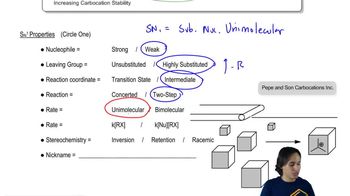
Understanding the properties of SN1.

Carbocation Stability

Carbocation stability is a crucial concept in organic chemistry, as it determines the reactivity of compounds in solvolysis reactions. Carbocations are positively charged carbon species, and their stability increases with the degree of substitution: tertiary (3°) carbocations are more stable than secondary (2°), which are more stable than primary (1°). This stability is due to hyperconjugation and inductive effects from surrounding alkyl groups, which can help stabilize the positive charge.
추천 영상:
05:58
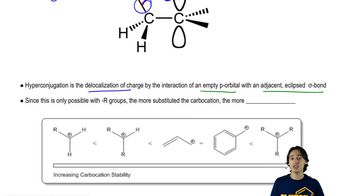
Determining Carbocation Stability

Nucleophilicity of Solvents

The nucleophilicity of solvents plays a significant role in solvolysis reactions. In aqueous ethanol, the solvent can act as a nucleophile, attacking the electrophilic carbon in the substrate. The strength of the nucleophile affects the reaction rate; stronger nucleophiles will lead to faster solvolysis. Additionally, the solvent's ability to stabilize the transition state and the carbocation intermediate can also influence the overall reaction kinetics.
추천 영상:
13:04
Nucleophilic Addition of Solvents