Ch.6 - Alkyl Halides; Nucleophilic Substitution
Wade - Organic Chemistry 9th Edition
Wade9th EditionOrganic ChemistryISBN: 9780135213728당신이 사용하는 게 아니라요?교과서 변경
6장, 문제 34c,d

Predict the compound in each pair that will undergo solvolysis (in aqueous ethanol) more rapidly.
(c) Two chemical structures are shown: one is a brominated cyclohexane, and the other is a brominated cyclopropane.


(d) Two chemical structures of cyclohexane derivatives, one with a chlorine atom and the other with an iodine atom, labeled "or."

검증된 단계별 안내
1
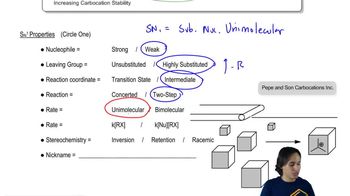
Step 1: Understand the concept of solvolysis. Solvolysis is a nucleophilic substitution reaction where the solvent acts as the nucleophile. In aqueous ethanol, the reaction typically proceeds via the SN1 mechanism, which involves the formation of a carbocation intermediate.
Step 2: Analyze the first pair of compounds (bromocyclohexane vs. cyclohexylmethyl bromide). The rate of solvolysis depends on the stability of the carbocation formed after the leaving group departs. Bromocyclohexane forms a secondary carbocation, while cyclohexylmethyl bromide forms a primary carbocation. Secondary carbocations are more stable than primary carbocations due to greater hyperconjugation and inductive effects.
Step 3: Compare the second pair of compounds (cyclohexyl chloride vs. cyclohexyl iodide). The leaving group ability is crucial in determining the rate of solvolysis. Iodide (I⁻) is a better leaving group than chloride (Cl⁻) because it is larger and more polarizable, making it easier to dissociate from the molecule.
Step 4: Consider the solvent effects. Aqueous ethanol is a polar protic solvent, which stabilizes carbocations and leaving groups. This further enhances the differences in carbocation stability and leaving group ability between the compounds.
Step 5: Predict the faster solvolysis reactions. For the first pair, bromocyclohexane will undergo solvolysis more rapidly due to the formation of a more stable secondary carbocation. For the second pair, cyclohexyl iodide will undergo solvolysis more rapidly due to the superior leaving group ability of iodide compared to chloride.

비슷한 문제에 대한 검증된 영상 답변:

이 영상 해법은 위 문제에 도움이 된다고 튜터들이 추천한 것입니다.
영상 길이:
2m
도움이 되었나요?

주요 개념

질문에 올바르게 답하기 위해 반드시 이해해야 하는 핵심 개념들은 다음과 같습니다.

Solvolysis

Solvolysis is a type of nucleophilic substitution reaction where a solvent acts as a nucleophile, typically resulting in the formation of an alcohol or other product. In aqueous ethanol, the solvent can stabilize the transition state and facilitate the reaction. The rate of solvolysis can be influenced by the structure of the substrate, including steric hindrance and the stability of the carbocation formed during the reaction.
추천 영상:
08:16
Understanding the properties of SN1.

Carbocation Stability

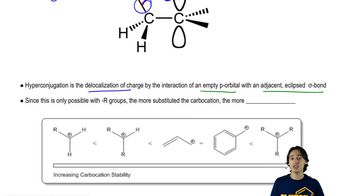
Carbocation stability is a crucial factor in determining the rate of solvolysis reactions. Carbocations are positively charged carbon species that can be stabilized by adjacent alkyl groups through hyperconjugation and inductive effects. Tertiary carbocations are more stable than secondary or primary ones, which means that compounds that can form more stable carbocations will undergo solvolysis more rapidly.
추천 영상:
05:58
Determining Carbocation Stability

Substituent Effects

The nature of substituents on a carbon skeleton can significantly affect the reactivity of a compound in solvolysis. Halogens, such as bromine and chlorine, can influence the rate of reaction based on their electronegativity and the bond strength with carbon. For example, iodine is a better leaving group than chlorine due to its larger size and weaker bond, which can lead to faster solvolysis in compounds containing iodine.
추천 영상:
가이드 코스
2:02
Directing Effects in Substituted Pyrroles, Furans, and Thiophenes Concept 1