Back
Back
Problem 1
Antibodies function to:
a. Directly destroy foreign organ grafts
b. Mark invading organisms for destruction
c. Kill intracellular viruses
d. Directly promote cytokine synthesis
e. Stimulate T cell growth
Problem 2
MHC class II molecules bind to _________ and trigger __________ .
a. endogenous antigens; cytotoxic T cells
b. exogenous antigens; cytotoxic T cells
c. antibodies; B cells
d. endogenous antigens; helper T cells
e. exogenous antigens; helper T cells
Problem 3
Rejection of a foreign skin graft is an example of:
a. Destruction of virus-infected cells
b. Tolerance
c. Antibody-mediated immunity
d. A secondary immune response
e. A cell-mediated immune response
Problem 5
Among the key molecules that control cell-mediated cytotoxicity are:
a. Perforin
b. Immunoglobulins
c. Complement
d. Cytokines
ie. Interferons
Problem 6
Which of the following lymphocytes predominates in blood?
a. T cells
b. B cells
c. Plasma cells
d. Memory cells
e. All are about equally prevalent
Problem 7
The major class of immunoglobulin found on the surfaces of the walls of the intestines and airways is secretory:
a. IgG
b. IgM
c. IgA
d. IgE
e. IgD
Problem 8
Which cells express MHC class I molecules in a patient?
a. Red blood cells
b. Antigen-presenting cells only
c. Neutrophils only
d. All nucleated cells
e. Dendritic cells only
Problem 9
In which of the following sites in the body can B cells be found?
a. Lymph nodes
b. Spleen
c. Red bone marrow
d. Intestinal wall
e. All of the above
Problem 10
Tc cells recognize epitopes only when the latter are held by:
a. MHC proteins
b. B cells
c. Interleukin 2
d. Granzyme
Problem 1
Mark each statement as either true or false. Rewrite false statements to make them true by changing the underlined words.
__________ MHC class II molecules are found on T cells.
Problem 2
Mark each statement as either true or false. Rewrite false statements to make them true by changing the underlined words.
__________ Apoptosis is the term used to describe cellular suicide.
Problem 3
Mark each statement as either true or false. Rewrite false statements to make them true by changing the underlined words.
__________ Lymphocytes with CD8 glycoprotein are helper T cells.
Problem 4
Mark each statement as either true or false. Rewrite false statements to make them true by changing the underlined words.
__________ Cytotoxic T cells secrete immunoglobulin.
Problem 5
Mark each statement as either true or false. Rewrite false statements to make them true by changing the underlined words.
__________ Secretion of antibodies by activated B cells is a form of cell-mediated immunity.
Problem 1a
Match each cell in the numbered list with its associated protein from the lettered list.
1. ___ Plasma cell
2. ___ Cytotoxic T cell
3. ___ Th2 cell
4. ___ Dendritic cell
A. MHC II molecule
B. Interleukin 4
C. Perforin and granzyme
D. Immunoglobulin
Problem 1b
Match each type of immunity in the numbered list with its associated example from the lettered list.
1. ___ Artificially acquired passive immunotherapy
2. ___ Naturally acquired active immunity
3. ___ Naturally acquired passive immunity
4. ___ Artificially acquired active immunity
A. Production of IgE in response to pollen
B. Acquisition of maternal antibodies in breast milk
C. Administration of tetanus toxoid
D. Administration of antitoxin
Problem 1
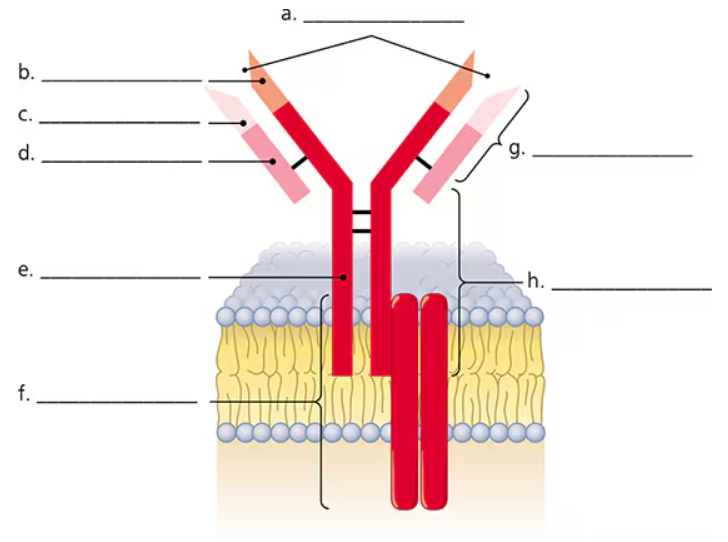
Label the parts of the immunoglobulin pictured here.
a. ________
b. ________
c. ________
d. ________
e. ________
f. ________
g. ________
h. ________
Problem 2
The nearby image is a transmission electron micrograph of a dendritic cell. Indicate where a scientist could find molecules of MHCI and MHC II. Label a pseudopod and a vesicle.
<IMAGE>