Problem 5.3
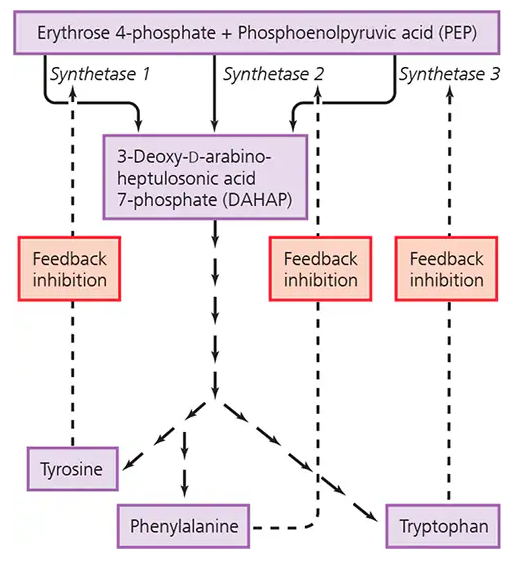
Examine the biosynthetic pathway for the production of the amino acids tryptophan, tyrosine, and phenylalanine in the figure. Where do the initial reactants (erythrose 4-phosphate and PEP) originate?
Problem 5.3a
For each of the phrases in questions 1–7, indicate the type of metabolism referred to, using the following choices:
a. anabolism only
b. both anabolism and catabolism (amphibolic)
c. catabolism only
Is exergonic
Problem 5.3a
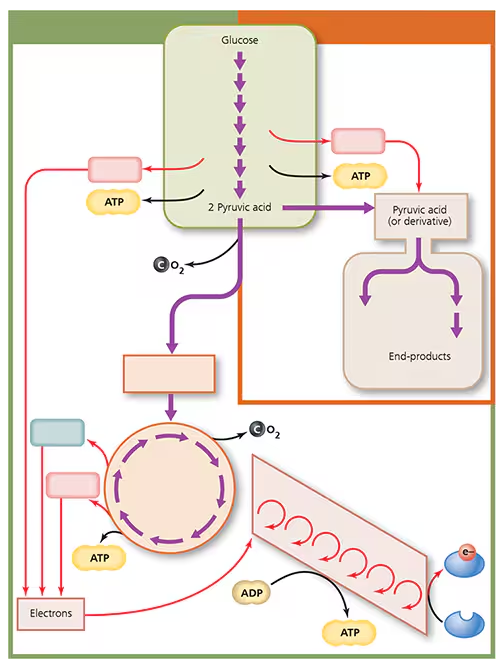
The initial catabolism of glucose occurs by glycolysis and/or the ________ and ________pathways.
Problem 5.3a
How do organisms control the rate of metabolic activities in their cells?
Problem 5.4
_______ is a cyclic series of eight reactions involved in the catabolism of acetyl-CoA that yields eight molecules of NADH and two molecules of FADH2.
Problem 5.4a
For each of the phrases in questions 1–7, indicate the type of metabolism referred to, using the following choices:
a. anabolism only
b. both anabolism and catabolism (amphibolic)
c. catabolism only
Is endergonic
Problem 5.4a
How does a noncompetitive inhibitor at a single allosteric site affect a whole pathway of enzymatic reactions?
Problem 5.5a
For each of the phrases in questions 1–7, indicate the type of metabolism referred to, using the following choices:
a. anabolism only
b. both anabolism and catabolism (amphibolic)
c. catabolism only
Involves the production of cell membrane constituents
Problem 5.5a
The final electron acceptor in aerobic respiration is ________.
Problem 5.5a
Explain the mechanism of negative feedback with respect to enzyme action.
Problem 5.6a
For each of the phrases in questions 1–7, indicate the type of metabolism referred to, using the following choices:
a. anabolism only
b. both anabolism and catabolism (amphibolic)
c. catabolism only
Includes hydrolytic reactions
Problem 5.6a
Three common inorganic electron acceptors in anaerobic respiration are _______,_______, and _______.
Problem 5.7a
For each of the phrases in questions 1–7, indicate the type of metabolism referred to, using the following choices:
a. anabolism only
b. both anabolism and catabolism (amphibolic)
c. catabolism only
Includes metabolism
Problem 5.7a
Anaerobic respiration typically uses (organic/inorganic)________ molecules as final electron acceptors.
Problem 5.7a
How does oxidation of a molecule occur without oxygen?
Problem 5.8
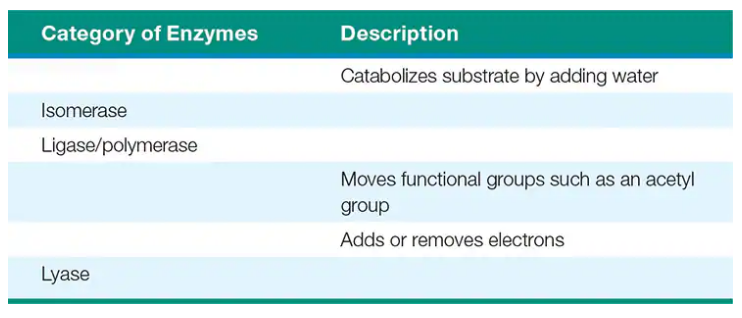
Complete the following chart:
The main coenzymes that carry electrons in catabolic pathways are _______ and ________.
Problem 5.8a
Redox reactions ______.
a. transfer energy
b. transfer electrons
c. involve oxidation and reduction
d. are involved in all of the above
Problem 5.9a
A reduced molecule ______.
a. has gained electrons
b. has become more positive in charge
c. has lost electrons
d. is an electron donor
Problem 5.9a
The use of a proton motive force to generate ATP is __________.
Problem 5.9a
Why do we breathe oxygen and give off carbon dioxide?
Problem 11.6a
Photosynthetic bacteria that also fix nitrogen are __________ .
a. mycoplasmas
b. spirilla
c. bacteroids
d. cyanobacteria
Problem 11.7a
For each of the following statements that is true, write “true” in the blank. For each statement that is false, write the word(s) that should be substituted for the underlined word(s) to make the statement correct.
__________ Pigments located in thylakoids in phototrophic bacteria trap light energy for metabolic processes.
Problem 26.1a
Food fermentations do all of the following except ________.
a. give foods a characteristic taste
b. lower the risk of food spoilage
c. sterilize foods
d. increase the shelf life of the food
Problem 26.10a
Industrial fermentation _________.
a. always involves alcohol production
b. involves the large-scale production of any beneficial compound
c. refers to the oxidation of sugars using organic electron acceptors
d. is any desirable change to food by microbial metabolism
Problem 26.1a
Indicate whether each of the following statements is true or false. Rewrite the underlined phrase to make a false statement true.
______The fermentation of dairy products relies on mixed acid fermentation.
Problem 26.10a
_________ is the amount of oxygen required by aerobic organisms to fully metabolize organic waste in water.
Problem 26.1a
Match each term with its correct definition.
1._______ Organisms whose presence in water indicates contamination from feces
2._______Refers to water that is fit to drink
3._______Used in the processing of animal wastes; mimics primary and secondary wastewater treatment
4._______Water that is not bound by solutes
5._______Undesirable fermentation reactions in food, leading to poor taste, smell, or appearance
6._______Brief heating of foods during processing
7._______Descriptor of the level of organic material present in wastewater
8._______Fermentative products produced by microorganisms during stationary phase
A. Spoilage
B. Water activity
C. Coliforms
D. Pasteurization
E. Secondary metabolites
F. Potable
G. BOD
H. Oxidation lagoon
Problem 26.1a
Label the steps in the cheese-making process.
<IMAGE>
Problem 26.2a
Commercially produced beers and wines are usually fermented with the aid of _______.
a. naturally occurring bacteria
b. naturally occurring yeast
c. specific cultured bacteria
d. specific cultured yeast
Problem 26.2a
Indicate whether each of the following statements is true or false. Rewrite the underlined phrase to make a false statement true.
______Sauerkraut production involves the alcoholic fermentation of cabbage.
Ch. 5 - Microbial Metabolism