Back
Back
Problem 1
If C. tetani is relatively sensitive to penicillin, why doesn’t penicillin cure tetanus?
Problem 2
What treatment is used against tetanus under the following conditions?
a. Before a person suffers a deep puncture wound
b. After a person suffers a deep puncture wound
Problem 3
Why is the following description used for wounds that are susceptible to C. tetani infection: “. . . Improperly cleaned deep puncture wounds . . . ones with little or no bleeding . . .”?
Problem 4
Provide the following information on poliomyelitis: etiology, method of transmission, symptoms, prevention. Why aren’t the Salk and Sabin vaccines considered treatments for poliomyelitis?
Problem 6
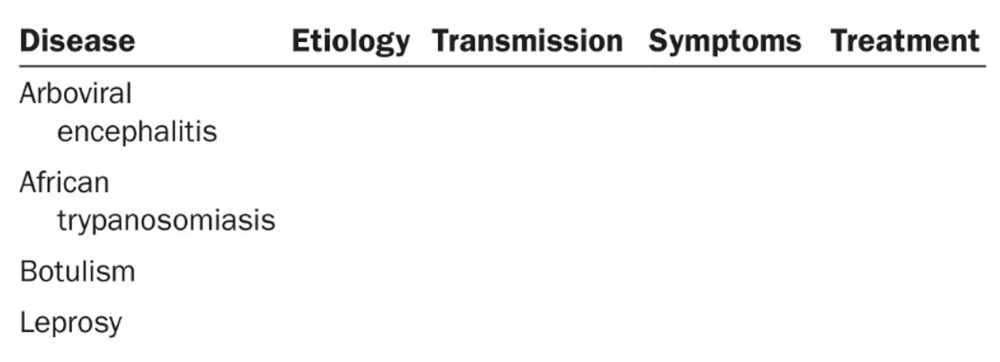
Fill in the following table:
Problem 7
Match the following choices to the statements in questions 7 and 8:
a. antirabies antibodies
b. HDCV
Produces longest lasting protection.
Problem 7a
On the following figure, identify the portal of entry of H. influenzae, C. tetani, botulinum toxin, M. leprae, poliovirus, Lyssavirus, arboviruses, and Acanthamoeba.
<IMAGE>
Problem 8
Match the following choices to the statements in questions 7 and 8:
a. antirabies antibodies
b. HDC
Used for passive immunization.
Problem 8a
Outline the procedures for treating rabies after exposure. Outline the procedures for preventing rabies prior to exposure. What is the reason for the differences in the procedures?
Problem 9
Provide evidence that Creutzfeldt-Jakob disease is caused by a transmissible agent.
Problem 10
This organism causes meningitis and is transmitted mainly by the inhalation of dried, contaminated bird droppings. Infections are treated with amphotericin B and flucytosine.
Problem 1
Which of the following is false?
a. Only puncture wounds by rusty nails result in tetanus.
b. Rabies is seldom found in rodents (e.g., rats, mice).
c. Polio is transmitted by the fecal-oral route.
d. Arboviral encephalitis is rather common in the United States.
e. All of the above are true.
Problem 2
Which of the following does not have an animal reservoir or vector?
a. Listeriosis
b. Cryptococcosis
c. Amebic meningoencephalitis
d. Rabies
e. African trypanosomiasis
Problem 3
A 12-year-old child hospitalized for Guillain-Barré syndrome had a 4-day history of headache, dizziness, fever, sore throat, and weakness of legs. Seizures began 2 weeks later. Bacterial cultures were negative. The child died 3 weeks after hospitalization. An autopsy revealed inclusions in brain cells that tested positive in an immunofluorescence test. This patient probably had
a. Rabies.
b. Creutzfeldt-Jakob disease.
c. Botulism.
d. Tetanus.
e. Leprosy.
Problem 4
After receiving a corneal transplant, a patient developed dementia and loss of motor function, then became comatose and died. Cultures were negative. Serological tests were negative. Autopsy revealed spongiform degeneration of brain tissue. The patient most likely had
a. Rabies.
b. Creutzfeldt-Jakob disease.
c. Botulism.
d. Tetanus.
e. Leprosy.
Problem 5
Endotoxin is responsible for symptoms caused by which of the following organisms?
a. N. meningitidis
b. S. pyogenes
c. L. monocytogenes
d. C. tetani
e. C. botulinum
Problem 6
The increased incidence of encephalitis in the summer months is due to
a. Maturation of the viruses.
b. Increased temperature.
c. The presence of adult mosquitoes.
d. An increased population of birds.
e. An increased population of horses.
Problem 9
Use the following choices to answer the question given below:
a. Cryptococcus
b. Haemophilus
c. Listeria
d. Naegleria
e. Neisseria
Microscopic examination of cerebrospinal fluid reveals gram-positive rods.
Problem 10
Use the following choices to answer the question given below:
a. Cryptococcus
b. Haemophilus
c. Listeria
d. Naegleria
e. Neisseria
Microscopic examination of cerebrospinal fluid from a person who washes windows on a building in a large city reveals ovoid cells.