Back
Back Tortora 14th EditionCh. 23 - Microbial Diseases of the Cardiovascular and Lymphatic Systems
Problem 1
Show the path of Streptococcus from a focal infection to the pericardium. Identify the portals of entry for T. cruzi, Orthohantavirus, and Cytomegalovirus.
<IMAGE>
Problem 2
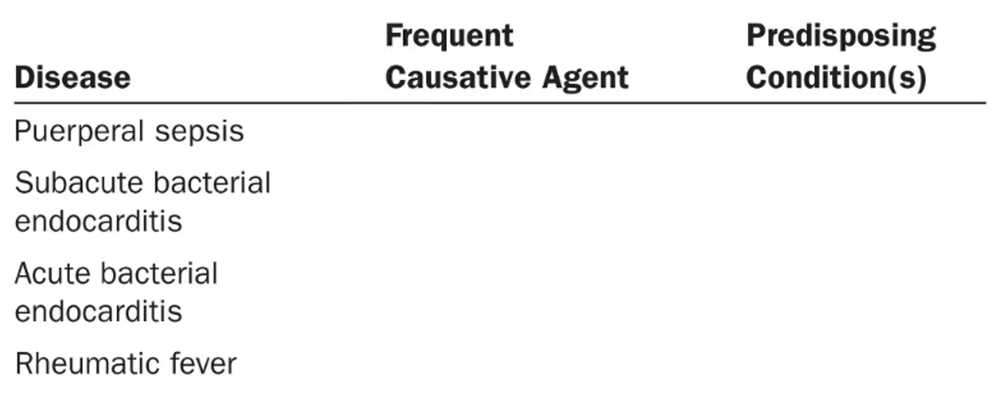
Complete the following table.
Problem 3
Compare and contrast epidemic typhus, endemic murine typhus, and tickborne typhus.
Problem 4
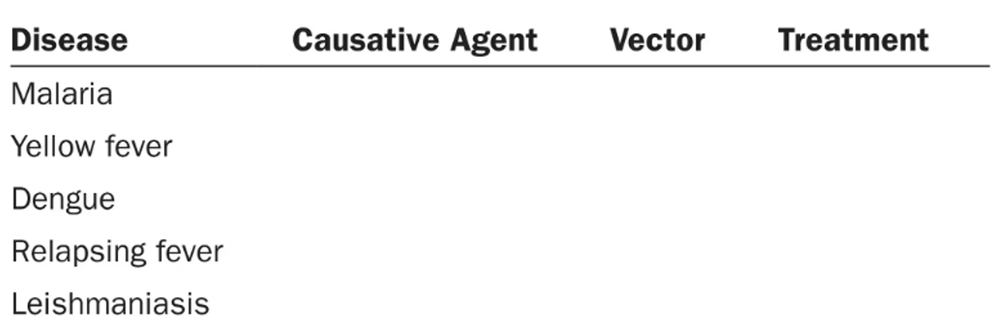
Complete the following table.
Problem 5
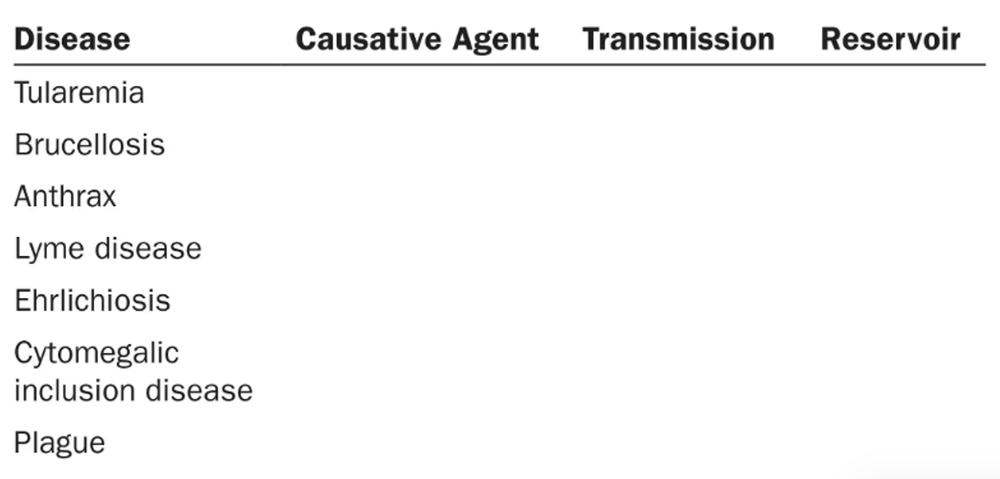
Complete the following table.
Problem 6
List the causative agent, method of transmission, and reservoir for schistosomiasis, toxoplasmosis, and Chagas disease. Which disease are you most likely to get in the United States? Where are the other diseases endemic?
Problem 7
Compare and contrast cat-scratch disease and toxoplasmosis.
Problem 8
Why is C. perfringens likely to grow in gangrenous wounds?
Problem 9
List the causative agent and method of transmission of infectious mononucleosis.
Problem 10
Most people have been infected with this microorganism, often without symptoms. Infection during pregnancy can result in deafness or intellectual disabilities in the newborn.
Problem 1
Use the following choices to answer the question given below:
a. Ehrlichiosis
b. Lyme disease
c. Septic shock
d. Toxoplasmosis
e. Viral hemorrhagic fever
A patient presents with a history of fever and headache. Bacterial cultures of blood, CSF, and stool are negative. What is your diagnosis?
Problem 2
Use the following choices to answer the question given below:
a. Ehrlichiosis
b. Lyme disease
c. Septic shock
d. Toxoplasmosis
e. Viral hemorrhagic fever
A patient was hospitalized because of continuing fever and progression of symptoms including headache, fatigue, and back pain. Tests for antibodies to B. burgdorferi were negative. What is your diagnosis?
Problem 3
Use the following choices to answer the question given below:
a. Ehrlichiosis
b. Lyme disease
c. Septic shock
d. Toxoplasmosis
e. Viral hemorrhagic fever
A patient complained of headache. A CT (computed tomography) scan revealed cysts of varying size in the patient’s brain. What is your diagnosis?
Problem 4
Use the following choices to answer the question given below:
a. Ehrlichiosis
b. Lyme disease
c. Septic shock
d. Toxoplasmosis
e. Viral hemorrhagic fever
A patient presents with mental confusion, rapid breathing and heart rate, and low blood pressure. What is your diagnosis?
Problem 5
A patient has a red circular rash on his arm and fever, malaise, and joint pain. The most appropriate treatment is
a. Antibiotics.
b. Chloroquine.
c. Anti-inflammatory drugs.
d. Antimony.
e. No treatment.
Problem 6
Which of the following is not a tickborne disease?
a. Babesiosis
b. Ehrlichiosis
c. Lyme disease
d. Relapsing fever
e. Tularemia
Problem 7
Use the following choices to answer the question given below:
a. Brucellosis
b. Malaria
c. Relapsing fever
d. Rocky Mountain spotted fever
e. Ebola
The patient’s fever spikes each evening. Oxidase-positive, gram-negative coccobacilli were isolated from a lesion on his arm. What is your diagnosis?
Problem 8
Use the following choices to answer the question given below:
a. Brucellosis
b. Malaria
c. Relapsing fever
d. Rocky Mountain spotted fever
e. Ebola
The patient was hospitalized with fever and headache. Spirochetes were observed in her blood. What is your diagnosis?
Problem 9
Which of these diseases has the highest incidence in the United States?
a. Brucellosis
b. Ebola
c. Malaria
d. Plague
e. Rocky Mountain spotted fever
Problem 10
Nineteen workers in a slaughterhouse developed fever and chills, with the fever spiking to 40°C each evening. The most likely method of transmission of this disease is
a. A vector.
b. The respiratory route.
c. A puncture wound.
d. An animal bite.
e. Water.