What are micronutrients, and which two main categories do they include?
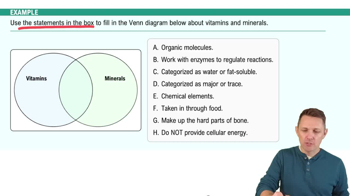
Micronutrients are nutrients required by the body in small amounts and include vitamins and minerals.
What distinguishes micronutrients from macronutrients in terms of their function and required amounts?
Micronutrients, such as vitamins and minerals, are needed in smaller amounts than macronutrients and do not provide energy but support various physiological functions.
How do vitamins interact with enzymes in the body?
Some vitamins work with enzymes to regulate chemical reactions in cells. For example, vitamin B3 is involved in enzyme activity.
What role does vitamin D play as a signaling molecule?
Vitamin D signals the body to absorb nutrients needed for bone development. It is essential for proper bone formation.
Which vitamins act as antioxidants, and what is their function?
Vitamins C and E act as antioxidants. They protect cells from damage.
What happens to excess water-soluble vitamins in the body?
Excess water-soluble vitamins are removed from the body in urine. They are not stored long-term.
Why can fat-soluble vitamins become toxic if consumed in excess?
Fat-soluble vitamins are stored in the body, so excess amounts can accumulate and cause toxicity. Severe toxicity, such as hypervitaminosis A, can even be deadly.
How are minerals classified based on the amount needed by the body?
Minerals are classified as major if more than 100 mg per day is needed and as trace if less than 100 mg per day is required. Examples of major minerals include calcium and sodium, while iron and iodine are trace minerals.
What structural role do minerals play in the body?
Minerals like calcium and phosphate are structural components of bones and teeth. They help maintain the integrity of these tissues.
When might supplementation of vitamins or minerals be recommended?
Supplementation may be necessary in specific cases, such as iron deficiency. Otherwise, a varied diet is generally recommended for obtaining micronutrients.
 Back
Back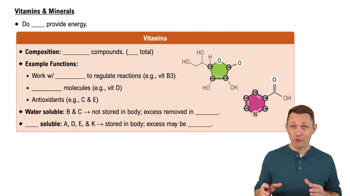
 06:03
06:03