Ch. 19 - More About Amines • Reactions of Heterocyclic Compounds
Bruice - Organic Chemistry 8th Edition
Bruice8th EditionOrganic ChemistryISBN: 9780135213711Not the one you use?Change textbook
Chapter 20, Problem 1c,d

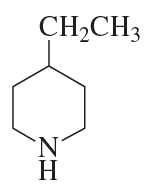
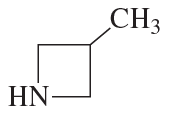
Name the following:
c. Chemical structure of a cyclic compound with a nitrogen atom, labeled with CH2 and CH3 groups.
d. Chemical structure of an epoxide with a nitrogen atom and a methyl group attached.

Verified step by step guidance
1
Step 1: Analyze the structure in part (i). The molecule contains a three-membered ring with an oxygen atom, which is an epoxide functional group. The chain attached to the epoxide is a propyl group.
Step 2: Determine the parent name for part (i). The parent name is based on the longest carbon chain, which is propane. The epoxide group is named as an oxirane.
Step 3: Assign the position of the substituent for part (i). The oxirane group is attached to the first carbon of the propane chain, making the name 1-(oxirane).
Step 4: Analyze the structure in part (ii). The molecule contains a five-membered ring with one nitrogen atom, which is a pyrrolidine ring. There are two methyl groups attached to the ring.
Step 5: Determine the positions of the substituents for part (ii). The methyl groups are attached to the second and third carbons of the pyrrolidine ring. The name will include the positions of these substituents, such as 2,3-dimethylpyrrolidine.

Verified video answer for a similar problem:

This video solution was recommended by our tutors as helpful for the problem above.
Video duration:
4m
Was this helpful?

Key Concepts

Here are the essential concepts you must grasp in order to answer the question correctly.

Epoxide Structure

Epoxides are three-membered cyclic ethers characterized by an oxygen atom bonded to two carbon atoms. This unique structure introduces significant ring strain, making epoxides highly reactive. Understanding the geometry and reactivity of epoxides is crucial for naming and predicting their chemical behavior.
Recommended video:
Guided course
02:19
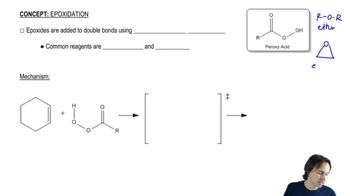
General properties of epoxidation.

Nomenclature of Organic Compounds

The IUPAC nomenclature system provides a standardized method for naming organic compounds based on their structure. Key rules include identifying the longest carbon chain, naming functional groups, and numbering the carbon atoms to give the lowest possible numbers to substituents. Mastery of these rules is essential for accurately naming compounds like the epoxides shown.

Recommended video:
Guided course
01:40
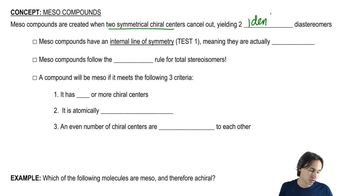
Defining meso compounds.

Functional Groups in Organic Chemistry

Functional groups are specific groups of atoms within molecules that determine the chemical properties and reactions of those molecules. In the context of the provided structures, recognizing the presence of the epoxide functional group and any other substituents (like amines or alkyl groups) is vital for proper identification and naming of the compounds.
Recommended video:
Guided course
02:36
Identifying Functional Groups