Ch. 16 - Reactions of Aldehydes and Ketones • More Reactions of Carboxylic Acid Derivatives
Bruice - Organic Chemistry 8th Edition
Bruice8th EditionOrganic ChemistryISBN: 9780135213711Not the one you use?Change textbook
Chapter 17, Problem 65c

Identify A through O:
Diagram illustrating a series of radical reactions with labeled steps A through O, showing chemical transformations and reagents.

Verified step by step guidance
1
Step 1: Analyze the starting material. The given compound is an alkene with a double bond between the second and third carbon atoms in a chain. The structure also includes a methyl group attached to the second carbon.
Step 2: Recognize the reaction type. The reagents R₂BH/THF followed by HO⁻, H₂O₂, and H₂O indicate a hydroboration-oxidation reaction. This reaction converts an alkene into an alcohol.
Step 3: Understand the regioselectivity of hydroboration. Hydroboration-oxidation follows anti-Markovnikov addition, meaning the hydroxyl group (-OH) will attach to the less substituted carbon of the double bond.
Step 4: Predict the intermediate. In the first step, the boron reagent (R₂BH) adds to the less substituted carbon of the double bond, forming an organoborane intermediate.
Step 5: Describe the final product. In the second step, oxidation with H₂O₂ and HO⁻ replaces the boron atom with a hydroxyl group (-OH), resulting in the formation of an alcohol at the less substituted carbon of the original double bond.

Verified video answer for a similar problem:

This video solution was recommended by our tutors as helpful for the problem above.
Video duration:
4m
Was this helpful?

Key Concepts

Here are the essential concepts you must grasp in order to answer the question correctly.

Hydroboration-Oxidation

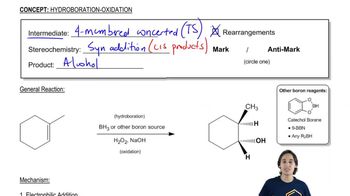
Hydroboration-oxidation is a two-step reaction process used to convert alkenes into alcohols. The first step involves the addition of borane (BH3) to the alkene, forming an organoborane intermediate. In the second step, this intermediate is oxidized using hydrogen peroxide (H2O2) and hydroxide ions (OH-), resulting in the formation of an alcohol with anti-Markovnikov selectivity.
Recommended video:
Guided course
06:38
General properties of hydroboration-oxidation.

Anti-Markovnikov Addition

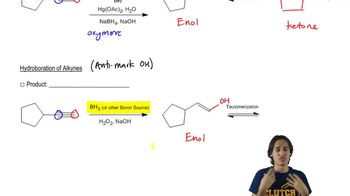
Anti-Markovnikov addition refers to the regioselectivity observed in certain reactions, where the less substituted carbon of an alkene receives the new substituent. In the context of hydroboration, this means that the boron atom attaches to the less substituted carbon, leading to the formation of an alcohol at that position after oxidation, which is contrary to the typical Markovnikov rule.
Recommended video:
Guided course
02:43
Anti-Markovnikov addition of alcohols to terminal alkynes yields aldehydes

Reagents and Solvents

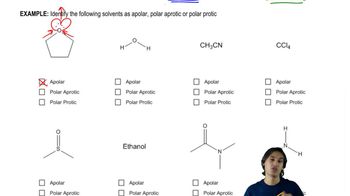
The choice of reagents and solvents is crucial in organic reactions. In hydroboration, R2BH (dialkylborane) is used as the boron source, and THF (tetrahydrofuran) serves as a solvent that stabilizes the reaction intermediates. The subsequent oxidation step employs HO-, H2O2, and H2O, which are essential for converting the organoborane into the corresponding alcohol, highlighting the importance of solvent and reagent compatibility in reaction mechanisms.
Recommended video:
Guided course
01:16
Identification of polarity in solvents