Ch. 13 - Alcohols, Ethers and Related Compounds: Substitution and Elimination
Mullins - Organic Chemistry: A Learner Centered Approach 1st Edition
Mullins1st EditionOrganic Chemistry: A Learner Centered ApproachISBN: 9780137566471Not the one you use?Change textbook
Chapter 12, Problem 106k(vii,viii)

Predict the product(s) that would result when molecules (a)–(p) are allowed to react under the following conditions:(vii) HCl; (viii) HBr If no reaction occurs, write 'no reaction.'


(k) Chemical structure of a cyclohexanol derivative with an attached hydroxyl group.

Verified step by step guidance
1
Identify the functional groups present in the given molecule (k) to determine its reactivity with HCl and HBr.
Consider the mechanism of reaction between the molecule and HCl or HBr. Typically, these reactions involve the addition of a halogen to a double bond or the substitution of a leaving group.
If the molecule contains a double bond, predict the addition of HCl or HBr across the double bond, following Markovnikov's rule, where the hydrogen atom adds to the carbon with more hydrogen atoms already attached.
If the molecule contains a leaving group, consider a substitution reaction where the halide ion (Cl⁻ or Br⁻) replaces the leaving group.
Evaluate the stability of any carbocation intermediates that may form during the reaction to predict the major product. If no suitable reaction pathway exists, conclude that there is 'no reaction.'

Verified video answer for a similar problem:

This video solution was recommended by our tutors as helpful for the problem above.
Was this helpful?

Key Concepts

Here are the essential concepts you must grasp in order to answer the question correctly.

Electrophilic Addition

Electrophilic addition is a fundamental reaction mechanism in organic chemistry where an electrophile reacts with a nucleophile, typically involving alkenes or alkynes. In the presence of strong acids like HCl or HBr, the double or triple bond of the unsaturated hydrocarbon acts as a nucleophile, attacking the electrophilic hydrogen atom, leading to the formation of a more stable carbocation intermediate.
Recommended video:
Guided course
09:23
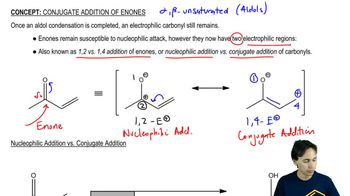
1,2 vs 1,4 Addition

Carbocation Stability

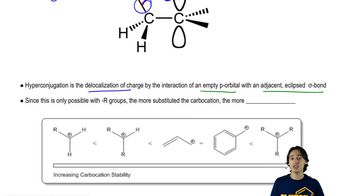
Carbocation stability is crucial in predicting the products of electrophilic addition reactions. Carbocations are positively charged carbon species, and their stability increases with the degree of substitution: tertiary carbocations are more stable than secondary, which are more stable than primary. Understanding the stability of the carbocation formed during the reaction helps in predicting the major product when reacting with HCl or HBr.
Recommended video:
Guided course
05:58
Determining Carbocation Stability

Regioselectivity

Regioselectivity refers to the preference of a chemical reaction to yield one structural isomer over others when multiple products are possible. In the context of electrophilic addition of HCl or HBr to alkenes, Markovnikov's rule often applies, indicating that the hydrogen atom will add to the carbon with the greater number of hydrogen substituents, leading to the formation of the more stable product. This concept is essential for predicting the outcome of the reactions described.
Recommended video:
Guided course
05:09
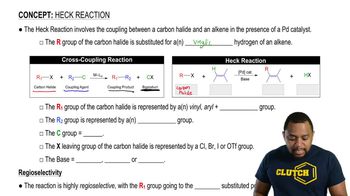
Heck Reaction
Related Practice
Textbook Question

Predict the product(s) that would result when molecules (a)–(p) are allowed to react under the following conditions: (i) SOCl₂ ; (ii) PBr₃. If no reaction occurs, write 'no reaction.'

(k)

702
views

Textbook Question

Predict the product(s) that would result when molecules (a)–(p) are allowed to react under the following conditions: (xi) HOCl, H2O (xii) HIO4 If no reaction occurs, write 'no reaction.'


(k)

715
views
Textbook Question

Predict the product(s) that would result when molecules (a)–(p) are allowed to react under the following conditions: (iii) SOCl₂ , NEt₃, and (iv) 1. TsCl, Et₃N 2. NaCN. If no reaction occurs, write 'no reaction.'

(k)

560
views
Textbook Question

Predict the product(s) that would result when molecules (a)–(p) are allowed to react under the following conditions: (i) SOCl₂ ; (ii) PBr₃ ; (iii) SOCl₂ , NEt₃ (iv) 1. TsCl, Et₃N 2. NaCN; (v) 1. TsCl, Et₃N 2. NaOt-Bu (vi) H₂SO₄ (vii) HCl; (viii) HBr; (ix) PCC; (x) H₂CrO₄ , H₂O (xi) HOCl, H₂O (xii) HIO₄ If no reaction occurs, write 'no reaction.'


(f)

805
views
Textbook Question

Predict the product(s) that would result when molecules (a)–(p) are allowed to react under the following conditions: (xi) HOCl, H₂O (xii) HIO₄ If no reaction occurs, write 'no reaction.'

(f)

690
views
Textbook Question

Predict the product(s) that would result when molecules (a)–(p) are allowed to react under the following conditions: (ix) PCC; (x) H₂CrO₄ , H₂O If no reaction occurs, write 'no reaction.'

(f)

736
views