2. Compare the numbers of dependent and independent variables in a multiple regression equation and a single regression equation.
Table of contents
- 1. Intro to Stats and Collecting Data1h 14m
- 2. Describing Data with Tables and Graphs1h 55m
- 3. Describing Data Numerically2h 5m
- 4. Probability2h 16m
- 5. Binomial Distribution & Discrete Random Variables3h 6m
- 6. Normal Distribution and Continuous Random Variables2h 11m
- 7. Sampling Distributions & Confidence Intervals: Mean3h 23m
- Sampling Distribution of the Sample Mean and Central Limit Theorem19m
- Distribution of Sample Mean - Excel23m
- Introduction to Confidence Intervals15m
- Confidence Intervals for Population Mean1h 18m
- Determining the Minimum Sample Size Required12m
- Finding Probabilities and T Critical Values - Excel28m
- Confidence Intervals for Population Means - Excel25m
- 8. Sampling Distributions & Confidence Intervals: Proportion1h 25m
- 9. Hypothesis Testing for One Sample3h 29m
- 10. Hypothesis Testing for Two Samples4h 50m
- Two Proportions1h 13m
- Two Proportions Hypothesis Test - Excel28m
- Two Means - Unknown, Unequal Variance1h 3m
- Two Means - Unknown Variances Hypothesis Test - Excel12m
- Two Means - Unknown, Equal Variance15m
- Two Means - Unknown, Equal Variances Hypothesis Test - Excel9m
- Two Means - Known Variance12m
- Two Means - Sigma Known Hypothesis Test - Excel21m
- Two Means - Matched Pairs (Dependent Samples)42m
- Matched Pairs Hypothesis Test - Excel12m
- 11. Correlation1h 24m
- 12. Regression1h 50m
- 13. Chi-Square Tests & Goodness of Fit2h 21m
- 14. ANOVA1h 57m
12. Regression
Linear Regression & Least Squares Method
Problem 9.4.5
Textbook Question
"Predicting y-Values In Exercises 3-6, use the multiple regression equation to predict the y-values for the values of the independent variables.
5. Black Cherry Tree Volume The volume (in cubic feet) of a black cherry tree can be modeled by the equation
y =- 52.2+0.3x_1 +4.5x_2
where x_1 is the tree's height (in feet) and x_2 is the tree's diameter (in inches). (Source: Journal of the Royal Statistical Society)
a. x_1 = 70, x_2 = 8.6
b. x_1 = 65, x_2 = 11.0
c. x_1 = 83, x_2 = 17.6
d. x_1 = 87, x_2 = 19.6"
Verified step by step guidance1
Identify the multiple regression equation given: , where is the tree's height and is the tree's diameter.
For each set of values for and , substitute the values into the regression equation. For example, for part (a), substitute and .
Calculate the product of each coefficient and its corresponding independent variable: multiply 0.3 by and 4.5 by .
Add the results from the multiplications to the intercept (-52.2) to find the predicted volume for each case.
Repeat steps 2 to 4 for parts (b), (c), and (d) using their respective values of and to find all predicted volumes.
Verified video answer for a similar problem:This video solution was recommended by our tutors as helpful for the problem above
Video duration:
2mPlay a video:
Was this helpful?
Key Concepts
Here are the essential concepts you must grasp in order to answer the question correctly.
Multiple Regression Equation
A multiple regression equation models the relationship between one dependent variable and two or more independent variables. It predicts the dependent variable (y) by combining the independent variables (x₁, x₂, etc.) multiplied by their coefficients, plus a constant term. This allows for understanding how each predictor influences the outcome.
Recommended video:
Guided course
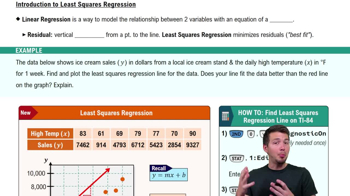
Intro to Least Squares Regression
Interpreting Coefficients
Coefficients in a regression equation represent the expected change in the dependent variable for a one-unit increase in the corresponding independent variable, holding others constant. For example, a coefficient of 0.3 for height means each additional foot increases volume by 0.3 cubic feet, assuming diameter stays the same.
Recommended video:
Guided course
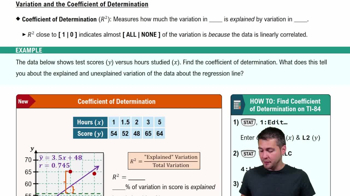
Coefficient of Determination
Prediction Using Regression
To predict y-values, substitute given values of independent variables into the regression equation and calculate the result. This process estimates the dependent variable based on the model, enabling practical predictions like estimating tree volume from height and diameter measurements.
Recommended video:
Guided course
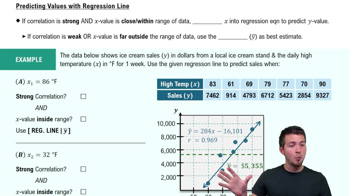
Using Regression Lines to Predict Values
Watch next
Master Intro to Least Squares Regression with a bite sized video explanation from Patrick
Start learningRelated Videos
Related Practice