
Which of the following is a feature of a dot plot?
Table of contents
- 1. Intro to Stats and Collecting Data1h 14m
- 2. Describing Data with Tables and Graphs1h 55m
- 3. Describing Data Numerically2h 5m
- 4. Probability2h 16m
- 5. Binomial Distribution & Discrete Random Variables3h 6m
- 6. Normal Distribution and Continuous Random Variables2h 11m
- 7. Sampling Distributions & Confidence Intervals: Mean3h 23m
- Sampling Distribution of the Sample Mean and Central Limit Theorem19m
- Distribution of Sample Mean - Excel23m
- Introduction to Confidence Intervals15m
- Confidence Intervals for Population Mean1h 18m
- Determining the Minimum Sample Size Required12m
- Finding Probabilities and T Critical Values - Excel28m
- Confidence Intervals for Population Means - Excel25m
- 8. Sampling Distributions & Confidence Intervals: Proportion1h 25m
- 9. Hypothesis Testing for One Sample3h 29m
- 10. Hypothesis Testing for Two Samples4h 50m
- Two Proportions1h 13m
- Two Proportions Hypothesis Test - Excel28m
- Two Means - Unknown, Unequal Variance1h 3m
- Two Means - Unknown Variances Hypothesis Test - Excel12m
- Two Means - Unknown, Equal Variance15m
- Two Means - Unknown, Equal Variances Hypothesis Test - Excel9m
- Two Means - Known Variance12m
- Two Means - Sigma Known Hypothesis Test - Excel21m
- Two Means - Matched Pairs (Dependent Samples)42m
- Matched Pairs Hypothesis Test - Excel12m
- 11. Correlation1h 24m
- 12. Regression1h 50m
- 13. Chi-Square Tests & Goodness of Fit2h 21m
- 14. ANOVA1h 57m
2. Describing Data with Tables and Graphs
Dot Plots
Problem 2.2.34
Textbook Question
Phone Screen Sizes Display the data below in a dot plot. Describe the differences in how the stem-and-leaf plot and the dot plot show patterns in the data.

Verified step by step guidance1
Step 1: Understand the stem-and-leaf plot provided. The stem represents the integer part of the phone screen sizes, and the leaf represents the decimal part. For example, '5|0' corresponds to a screen size of 5.0 inches.
Step 2: Extract the data from the stem-and-leaf plot. The screen sizes are: 5.0, 5.0, 5.5, 5.5, 5.6, 5.7, 5.8, 5.8, 5.9, 6.0, 6.0, 6.1, 6.2, 6.3, 6.4, 6.5, 6.5, 6.6, 6.8, 6.8, 6.9, 7.0, and 7.0.
Step 3: Create a dot plot using the extracted data. For each unique screen size, place a dot above the corresponding value on a number line. For example, for 5.0 inches, place two dots above 5.0 since it appears twice in the data.
Step 4: Compare the stem-and-leaf plot and the dot plot. The stem-and-leaf plot organizes the data by grouping screen sizes based on their integer part, making it easier to see clusters and individual values. The dot plot visually represents the frequency of each screen size, making it easier to identify patterns such as the most common sizes.
Step 5: Summarize the differences. The stem-and-leaf plot provides a compact numerical representation, while the dot plot offers a visual frequency distribution. Both are useful for identifying patterns, but the dot plot is more intuitive for visualizing the spread and frequency of the data.
Verified video answer for a similar problem:This video solution was recommended by our tutors as helpful for the problem above
Video duration:
3mPlay a video:
Was this helpful?
Key Concepts
Here are the essential concepts you must grasp in order to answer the question correctly.
Stem-and-Leaf Plot
A stem-and-leaf plot is a method of displaying quantitative data in a graphical format, similar to a histogram. It separates each data point into a 'stem' (the leading digit or digits) and a 'leaf' (the trailing digit). This format allows for easy visualization of the distribution of data while preserving the original values, making it useful for identifying patterns, such as clusters or gaps in the data.
Recommended video:
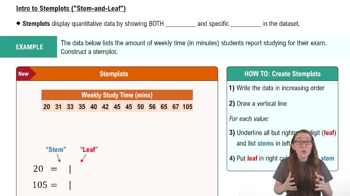
Creating Stemplots
Dot Plot
A dot plot is a simple graphical display that uses dots to represent individual data points along a number line. Each dot corresponds to a value in the dataset, allowing for a quick visual assessment of frequency and distribution. Dot plots are particularly effective for small datasets, as they clearly show the shape of the data distribution and highlight any outliers or clusters.
Recommended video:
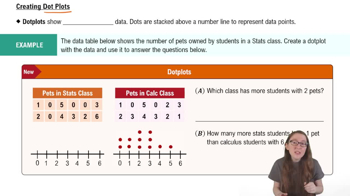
Creating Dotplots
Data Visualization
Data visualization is the graphical representation of information and data. By using visual elements like charts, graphs, and maps, it helps to communicate complex data clearly and efficiently. Effective data visualization allows for easier interpretation of patterns, trends, and outliers, enabling better decision-making based on the insights derived from the data.
Recommended video:
Guided course
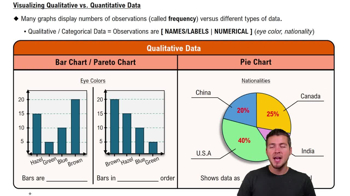
Visualizing Qualitative vs. Quantitative Data
Related Videos
Related Practice
Multiple Choice
20
views
