Back

Visualizing Qualitative vs. Quantitative Data definitions

Control buttons has been changed to "navigation" mode.
1/15
  • Qualitative Data

    Observations represented by names or labels, not numbers; often visualized with charts showing categories.
  • Quantitative Data

    Observations expressed as numerical values; suitable for charts displaying continuous or discrete numbers.
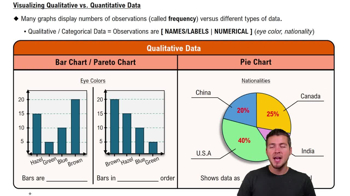
  • Bar Chart

    Vertical bars display frequencies for categories; bar height reflects the number of observations.
  • Pareto Chart

    Special bar chart with bars arranged in descending order to highlight the most significant categories.
  • Pie Chart

    Circular chart divided into wedges, each representing a category's percentage of the total dataset.
  • Histogram

    Bar graph for numerical data; bars touch to indicate continuous classes, showing frequency distribution.
  • Frequency Polygon

    Line graph alternative to a histogram; points connected by lines represent frequencies for numerical classes.
  • Stem-and-Leaf Plot

    Table format splitting numbers into stems and leaves, revealing actual data values and their frequency.
  • Frequency

    Count of observations within a category or class; fundamental for interpreting charts and distributions.
  • Category

    Distinct group or label used in qualitative data; forms the basis for grouping in bar and pie charts.
  • Class

    Interval or range of numerical values used in quantitative charts like histograms and frequency polygons.
  • Proportion

    Fraction or percentage of the total represented by a category; often visualized in pie charts.
  • Central Tendency

    Statistical concept describing the center or typical value in a dataset, relevant in data visualization.
  • Variability

    Measure of how spread out data values are; important for understanding distributions in visualizations.
  • Descriptive Statistics

    Methods for summarizing and visualizing data, including charts and measures of frequency and spread.