Ch. 4 - Graphs of the Circular Functions
Lial - Trigonometry 12th Edition
Lial12th EditionTrigonometryISBN: 9780136552161Not the one you use?Change textbook
Chapter 5, Problem 4.35

Graph each function over a two-period interval. Give the period and amplitude. See Examples 2–5.
y = -2 sin 2 πx

Verified step by step guidance
1
Identify the standard form of the sine function, which is \( y = a \sin(bx + c) + d \). In this case, \( y = -2 \sin(2\pi x) \).
Determine the amplitude of the function. The amplitude is the absolute value of the coefficient \( a \). Here, \( a = -2 \), so the amplitude is \(|-2| = 2\).
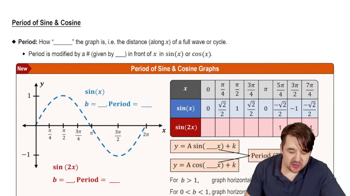
Find the period of the function. The period of a sine function is given by \( \frac{2\pi}{b} \), where \( b \) is the coefficient of \( x \). In this case, \( b = 2\pi \), so the period is \( \frac{2\pi}{2\pi} = 1 \).
Graph the function over a two-period interval. Since the period is 1, a two-period interval would be from \( x = 0 \) to \( x = 2 \).
Plot key points of the sine function within the interval, considering the amplitude and period. The key points for one period of \( y = \sin(x) \) are at \( x = 0, \frac{1}{4}, \frac{1}{2}, \frac{3}{4}, 1 \). Adjust these points for the given function \( y = -2 \sin(2\pi x) \).

Verified video answer for a similar problem:

This video solution was recommended by our tutors as helpful for the problem above.
Was this helpful?

Key Concepts

Here are the essential concepts you must grasp in order to answer the question correctly.

Period of a Trigonometric Function

The period of a trigonometric function is the length of one complete cycle of the wave. For the sine function, the standard period is 2π. However, when the function is modified, such as in y = -2 sin(2πx), the period can be calculated by dividing the standard period by the coefficient of x, which in this case is 2π, resulting in a period of 1.
Recommended video:
5:33
Period of Sine and Cosine Functions

Amplitude of a Trigonometric Function

The amplitude of a trigonometric function refers to the maximum distance the function reaches from its midline. In the function y = -2 sin(2πx), the amplitude is given by the absolute value of the coefficient in front of the sine function, which is 2. This means the graph will oscillate between -2 and 2, but since the sine function is negated, it will reflect the wave vertically.
Recommended video:
6:04
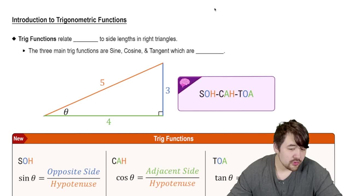
Introduction to Trigonometric Functions

Graphing Sine Functions

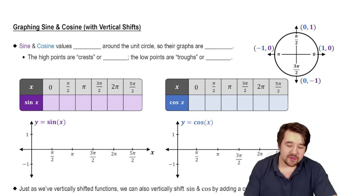
Graphing sine functions involves plotting the values of the function over a specified interval. For y = -2 sin(2πx), the graph will show a wave that oscillates between -2 and 0, with a period of 1. Understanding how to identify key points, such as the maximum, minimum, and intercepts, is essential for accurately representing the function over the given interval.
Recommended video:
5:53
Graph of Sine and Cosine Function