Ch. 2 - Acute Angles and Right Triangles
Lial - Trigonometry 12th Edition
Lial12th EditionTrigonometryISBN: 9780136552161Not the one you use?Change textbook
Chapter 3, Problem 2.3.10

CONCEPT PREVIEW Match each trigonometric function value or angle in Column I with its appropriate approximation in Column II.


Column I: 1.
cot⁻¹ 30
Column II:
A. 88.09084757°
B. 63.25631605°
C. 1.909152433°
D. 17.45760312°
E. 0.2867453858
F. 1.962610506
G. 14.47751219°
H. 1.015426612
I. 1.051462224
J. 0.9925461516

Verified step by step guidance
1
Step 1: Understand the inverse trigonometric function involved. Here, \( \cot^{-1} 30 \) means the angle whose cotangent is 30.
Step 2: Recall the relationship between cotangent and tangent: \( \cot \theta = \frac{1}{\tan \theta} \). So, \( \cot^{-1} 30 = \theta \) implies \( \tan \theta = \frac{1}{30} \).
Step 3: To find the angle \( \theta \), use the inverse tangent function: \( \theta = \tan^{-1} \left( \frac{1}{30} \right) \).
Step 4: Calculate \( \tan^{-1} \left( \frac{1}{30} \right) \) using a calculator or trigonometric tables to find the angle in degrees or radians, depending on the context.
Step 5: Match the calculated angle with the closest approximation given in Column II to complete the pairing.

Verified video answer for a similar problem:

This video solution was recommended by our tutors as helpful for the problem above.
Video duration:
5m
Was this helpful?

Key Concepts

Here are the essential concepts you must grasp in order to answer the question correctly.

Inverse Trigonometric Functions

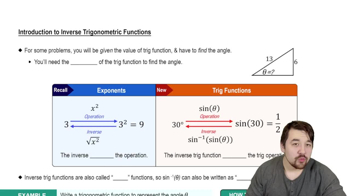
Inverse trigonometric functions, such as cot⁻¹ (arccotangent), are used to find the angle whose trigonometric ratio equals a given value. For example, cot⁻¹(30) gives the angle whose cotangent is 30. Understanding these functions is essential for converting between angle measures and ratio values.
Recommended video:
4:28
Introduction to Inverse Trig Functions

Angle Measurement and Approximation

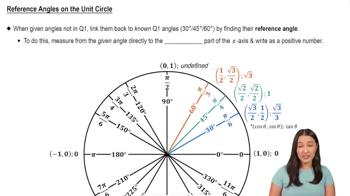
Angles can be measured in degrees or radians and often require approximation for practical use. Matching trigonometric values to their angle approximations involves understanding how to interpret and convert between exact values and decimal approximations, which is crucial for solving problems involving trigonometric functions.
Recommended video:
5:31
Reference Angles on the Unit Circle

Trigonometric Ratios and Their Properties

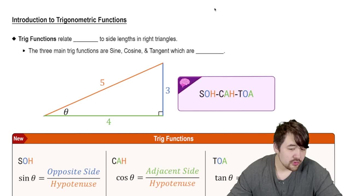
Trigonometric ratios like sine, cosine, tangent, and cotangent relate the angles of a right triangle to the ratios of its sides. Knowing the properties and ranges of these ratios helps in identifying correct angle-value pairs and understanding the behavior of these functions across different quadrants.
Recommended video:
6:04
Introduction to Trigonometric Functions
Related Practice
Textbook Question

Find a value of θ in the interval [0°, 90°) that satisfies each statement. Give answers in decimal degrees to six decimal places. See Example 2.

cos θ = 0.85536428

615
views

Textbook Question

(Modeling) Fish's View of the World The figure shows a fish's view of the world above the surface of the water. (Data from Walker, J., 'The Amateur Scientist,' Scientific American.) Suppose that a light ray comes from the horizon, enters the water, and strikes the fish's eye. Assume that this ray gives a value of 90° for angle θ₁ in the formula for Snell's law. (In a practical situation, this angle would probably be a little less than 90°.) The speed of light in water is about 2.254 x 10⁸ m per sec. Find angle θ₂ to the nearest tenth.

606
views
Textbook Question

Concept Check The two methods of expressing bearing can be interpreted using a rectangular coordinate system. Suppose that an observer for a radar station is located at the origin of a coordinate system. Find the bearing of an airplane located at each point. Express the bearing using both methods. (0, -2)

1029
views
Textbook Question

Solve each problem. See Examples 3 and 4. Height of an Antenna A scanner antenna is on top of the center of a house. The angle of elevation from a point 28.0 m from the center of the house to the top of the antenna is 27°10', and the angle of elevation to the bottom of the antenna is 18°10'. Find the height of the antenna.

861
views
Textbook Question

Find two angles in the interval [0°, 360°) that satisfy each of the following. Round answers to the nearest degree. cos θ = 0.10452846

608
views
Textbook Question

Find a value of θ in the interval [0°, 90°) that satisfies each statement. Give answers in decimal degrees to six decimal places. See Example 2.

sin θ = 0.84802194

692
views