
Ch. 6 - Inverse Circular Functions and Trigonometric Equations
Lial - Trigonometry 12th Edition
Lial12th EditionTrigonometryISBN: 9780136552161Not the one you use?Change textbook
Chapter 7, Problem 6.2.51

Solve each equation (x in radians and θ in degrees) for all exact solutions where appropriate. Round approximate answers in radians to four decimal places and approximate answers in degrees to the nearest tenth. Write answers using the least possible nonnegative angle measures.
6 sin² θ + sin θ = 1

Verified step by step guidance
1
Rewrite the given equation in terms of \( \sin \theta \): \[ 6 \sin^{2} \theta + \sin \theta = 1 \].
Bring all terms to one side to form a quadratic equation in \( \sin \theta \): \[ 6 \sin^{2} \theta + \sin \theta - 1 = 0 \].
Let \( u = \sin \theta \). Substitute to get \( 6u^{2} + u - 1 = 0 \).
Solve the quadratic equation \( 6u^{2} + u - 1 = 0 \) using the quadratic formula: \[ u = \frac{-b \pm \sqrt{b^{2} - 4ac}}{2a} \] where \( a=6 \), \( b=1 \), and \( c=-1 \).
For each solution \( u \), check if it lies within the valid range for sine (\( -1 \leq u \leq 1 \)). Then solve for \( \theta \) by finding \( \theta = \arcsin(u) \) and use the unit circle to find all solutions within the specified domain, expressing answers in degrees and radians as required.

Verified video answer for a similar problem:

This video solution was recommended by our tutors as helpful for the problem above.
Was this helpful?

Key Concepts

Here are the essential concepts you must grasp in order to answer the question correctly.

Solving Quadratic Trigonometric Equations

This involves rewriting the trigonometric equation in a quadratic form, such as a sin²θ + b sinθ + c = 0, and then solving for the trigonometric function (e.g., sinθ) using algebraic methods like factoring or the quadratic formula.
Recommended video:
6:24
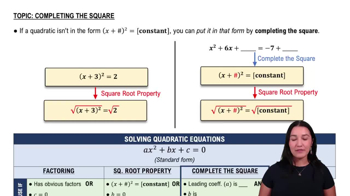
Solving Quadratic Equations by Completing the Square

General Solutions for Sine Equations

Once sinθ is found, the general solutions for θ are determined using the unit circle properties: θ = arcsin(value) + 2πn and θ = π - arcsin(value) + 2πn for integer n, ensuring all possible angles are considered.
Recommended video:
4:25
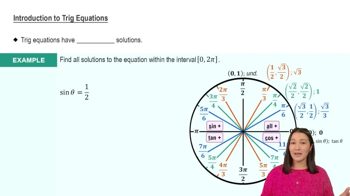
Introduction to Trig Equations

Converting Between Radians and Degrees and Using Least Nonnegative Angles

Understanding how to convert between radians and degrees is essential for expressing answers correctly. Additionally, solutions should be expressed as the smallest nonnegative angle within one full rotation (0 to 2π radians or 0° to 360°), rounding as specified.
Recommended video:
5:04
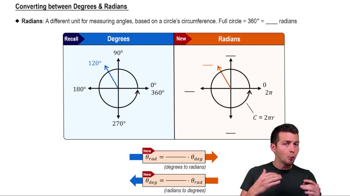
Converting between Degrees & Radians