In Exercises 1–4, u and v have the same direction. In each exercise:Is u = v? Explain.
Verified step by step guidance
1
insert step 1: Understand that vectors u and v having the same direction means they are scalar multiples of each other.
insert step 2: Express vector u as u = k * v, where k is a scalar.
insert step 3: Determine if the scalar k is equal to 1. If k = 1, then u = v.
insert step 4: If k is not equal to 1, then u is not equal to v, even though they have the same direction.
insert step 5: Conclude that for u to be equal to v, they must not only have the same direction but also the same magnitude, which means k must be 1.
Verified video answer for a similar problem:
This video solution was recommended by our tutors as helpful for the problem above
Video duration:
2m
Play a video:
Was this helpful?
Key Concepts
Here are the essential concepts you must grasp in order to answer the question correctly.
Vector Direction
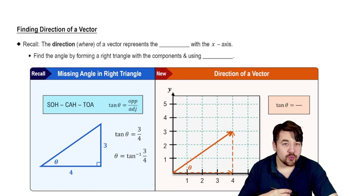
In trigonometry and vector analysis, the direction of a vector is defined by the angle it makes with a reference axis. Two vectors are said to have the same direction if they point in the same way, regardless of their magnitudes. This concept is crucial for understanding vector equality and operations involving vectors.
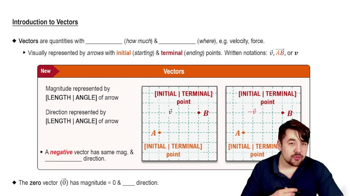
Two vectors are considered equal if they have the same magnitude and direction. This means that even if two vectors are represented differently (e.g., different lengths), they can still be equal if they point in the same direction. Understanding this concept is essential for answering questions about the relationship between vectors u and v.
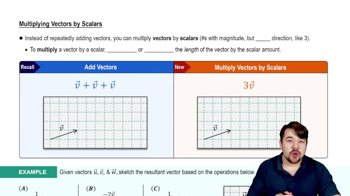
Scalar multiplication involves multiplying a vector by a scalar (a real number), which changes the magnitude of the vector but not its direction. If vectors u and v have the same direction, one can be expressed as a scalar multiple of the other. This relationship is key to determining whether u equals v in terms of direction and magnitude.