
Ch. 6 - Inverse Circular Functions and Trigonometric Equations
Lial - Trigonometry 12th Edition
Lial12th EditionTrigonometryISBN: 9780136552161Not the one you use?Change textbook
Chapter 7, Problem 6.2.39

Solve each equation over the interval [0°, 360°). Write solutions as exact values or to the nearest tenth, as appropriate.
9 sin² θ ― 6 sin² θ = 1

Verified step by step guidance
1
Start by simplifying the given equation: \(9 \sin^{2} \theta - 6 \sin^{2} \theta = 1\). Combine like terms on the left side to get a simpler expression.
After simplification, you will have an equation in terms of \(\sin^{2} \theta\). Isolate \(\sin^{2} \theta\) by dividing both sides of the equation by the coefficient of \(\sin^{2} \theta\).
Once you have \(\sin^{2} \theta = k\) (where \(k\) is a constant), take the square root of both sides to solve for \(\sin \theta\). Remember to consider both the positive and negative roots because \(\sin \theta\) can be positive or negative in the interval \([0^\circ, 360^\circ)\).
Use the inverse sine function to find the reference angle(s) corresponding to the values of \(\sin \theta\). This will give you the principal solutions.
Determine all solutions for \(\theta\) in the interval \([0^\circ, 360^\circ)\) by considering the signs of \(\sin \theta\) in the four quadrants and using the reference angles found in the previous step.

Verified video answer for a similar problem:

This video solution was recommended by our tutors as helpful for the problem above.
Was this helpful?

Key Concepts

Here are the essential concepts you must grasp in order to answer the question correctly.

Trigonometric Equations

Trigonometric equations involve functions like sine, cosine, and tangent. Solving these equations means finding all angle values within a given interval that satisfy the equation. Understanding how to manipulate and simplify these equations is essential for finding exact or approximate solutions.
Recommended video:
4:34
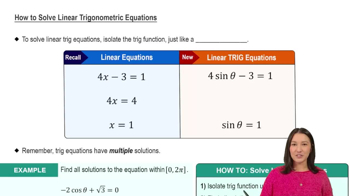
How to Solve Linear Trigonometric Equations

Pythagorean Identity

The Pythagorean identity states that sin²θ + cos²θ = 1 for any angle θ. This fundamental relationship allows substitution between sine and cosine terms, helping to simplify or transform equations involving squared trigonometric functions.
Recommended video:
6:25
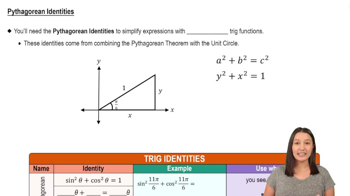
Pythagorean Identities

Interval and Solution Representation

When solving trigonometric equations over a specific interval, such as [0°, 360°), it is important to find all solutions within that range. Solutions can be expressed as exact values (like fractions of π or special angles) or decimal approximations rounded to a specified precision.
Recommended video:
4:03
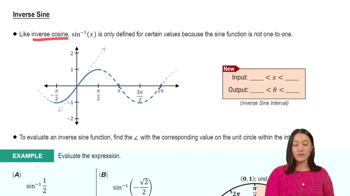
Inverse Sine