Textbook Question
Solve each equation for all exact solutions, in degrees.
2√3 cos (θ/2) = -3
34
views

 Lial 12th EditionCh. 6 - Inverse Circular Functions and Trigonometric EquationsProblem 6.3.33
 Verified step by step guidance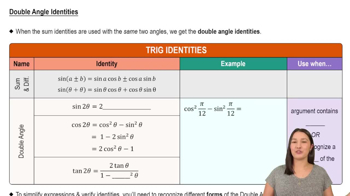
 05:06
05:06
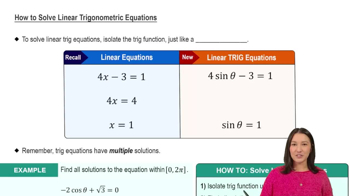 4:34
4:34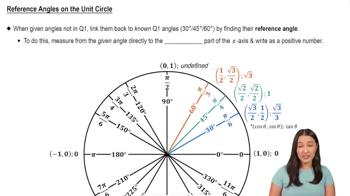 5:31
5:31Solve each equation for all exact solutions, in degrees.
2√3 cos (θ/2) = -3
Solve each equation over the interval [0°, 360°). Write solutions as exact values or to the nearest tenth, as appropriate.
9 sin² θ ― 6 sin² θ = 1
Solve each equation in x over the interval [0, 2π) and each equation in θ over the interval [0°, 360°). Give exact solutions.
sin x = sin 2x
Solve each equation (x in radians and θ in degrees) for all exact solutions where appropriate. Round approximate answers in radians to four decimal places and approximate answers in degrees to the nearest tenth. Write answers using the least possible nonnegative angle measures.
2 sin θ = 2 cos 2θ
Solve each equation over the interval [0°, 360°). Write solutions as exact values or to the nearest tenth, as appropriate.
csc² θ ―2 cot θ = 0
Solve each equation for exact solutions.
tan⁻¹ x - tan⁻¹ (1/x ) = π/6