Ch. 2 - Graphs of the Trigonometric Functions; Inverse Trigonometric Functions
Chapter 2, Problem 1

In Exercises 1–6, determine the amplitude of each function. Then graph the function and y = sin x in the same rectangular coordinate system for 0 ≤ x ≤ 2π.y = 4 sin x

Verified step by step guidance
1
Identify the general form of the sine function, which is \( y = a \sin(bx + c) + d \).
Recognize that in the given function \( y = 4 \sin x \), the coefficient \( a = 4 \).
Understand that the amplitude of a sine function is the absolute value of the coefficient \( a \), which is \( |a| \).
Calculate the amplitude by taking the absolute value of \( a \), which is \( |4| \).
Graph the function \( y = 4 \sin x \) and \( y = \sin x \) on the same coordinate system for \( 0 \leq x \leq 2\pi \), noting that the amplitude of \( y = 4 \sin x \) is 4, while the amplitude of \( y = \sin x \) is 1.

Verified video answer for a similar problem:

This video solution was recommended by our tutors as helpful for the problem above.
Video duration:
4m
Was this helpful?

Key Concepts

Here are the essential concepts you must grasp in order to answer the question correctly.

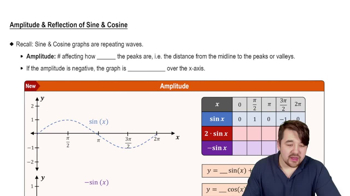
Amplitude

Amplitude refers to the maximum distance a wave or oscillating function reaches from its central position. In the context of sine functions, it is the coefficient in front of the sine term, which determines how 'tall' or 'short' the wave appears. For the function y = 4 sin x, the amplitude is 4, indicating that the wave oscillates between 4 and -4.
Recommended video:
5:05
Amplitude and Reflection of Sine and Cosine

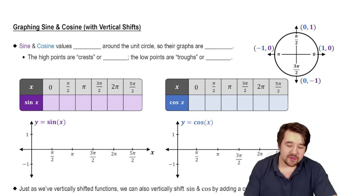
Sine Function

The sine function is a fundamental periodic function in trigonometry, defined as the ratio of the length of the opposite side to the hypotenuse in a right triangle. It produces a smooth, continuous wave that oscillates between -1 and 1. When scaled by a factor, such as in y = 4 sin x, the sine function's range is adjusted accordingly, affecting its amplitude.
Recommended video:
5:53
Graph of Sine and Cosine Function

Graphing Trigonometric Functions

Graphing trigonometric functions involves plotting their values over a specified interval, typically using the x-axis for the angle (in radians) and the y-axis for the function's value. For y = 4 sin x, the graph will show a wave oscillating between 4 and -4 over the interval from 0 to 2π. Understanding how to graph these functions helps visualize their behavior and relationships with other functions, such as y = sin x.
Recommended video:
6:04
Introduction to Trigonometric Functions