Ch. 2 - Graphs of the Trigonometric Functions; Inverse Trigonometric Functions
Blitzer - Trigonometry 3rd Edition
Blitzer3rd EditionTrigonometryISBN: 9780137316601Not the one you use?Change textbook
Chapter 2, Problem 1

Find the exact value of each expression. sin⁻¹ 1/2

Verified step by step guidance
1
Recognize that the expression \( \sin^{-1} \frac{1}{2} \) represents the inverse sine (arcsine) function, which gives the angle whose sine is \( \frac{1}{2} \).
Recall the range of the inverse sine function, which is \( \left[ -\frac{\pi}{2}, \frac{\pi}{2} \right] \), meaning the angle you find must lie within this interval.
Identify the angle \( \theta \) such that \( \sin \theta = \frac{1}{2} \) within the principal range. Use your knowledge of special angles on the unit circle.
Remember that \( \sin \frac{\pi}{6} = \frac{1}{2} \), so \( \theta = \frac{\pi}{6} \) is the angle that satisfies the equation within the allowed range.
Conclude that \( \sin^{-1} \frac{1}{2} = \frac{\pi}{6} \) as the exact value of the expression.

Verified video answer for a similar problem:

This video solution was recommended by our tutors as helpful for the problem above.
Video duration:
4m
Was this helpful?

Key Concepts

Here are the essential concepts you must grasp in order to answer the question correctly.

Inverse Sine Function (sin⁻¹ or arcsin)

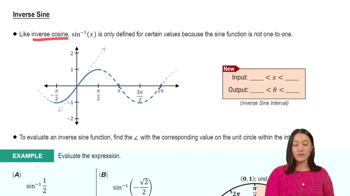
The inverse sine function, denoted as sin⁻¹ or arcsin, returns the angle whose sine value is a given number. It is defined for inputs between -1 and 1 and outputs angles in the range [-π/2, π/2] or [-90°, 90°]. Understanding this helps find the angle corresponding to a sine value.
Recommended video:
4:03
Inverse Sine

Exact Values of Sine for Special Angles

Certain angles have well-known sine values, such as sin(30°) = 1/2 or sin(π/6) = 1/2. Recognizing these special angles allows you to determine the exact angle for a given sine value without a calculator.
Recommended video:
3:28
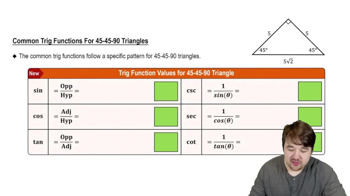
Common Trig Functions For 45-45-90 Triangles

Domain and Range Restrictions of Inverse Trigonometric Functions

Inverse trig functions have restricted domains and ranges to ensure they are functions. For sin⁻¹, the input must be between -1 and 1, and the output angle lies between -90° and 90°. This restriction ensures a unique angle is returned for each sine value.
Recommended video:
4:22
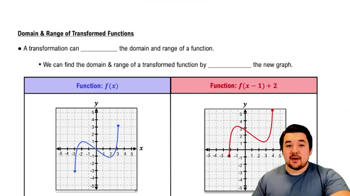
Domain and Range of Function Transformations