Pearson+ LogoPearson+ Logo
Ch. 2 - Graphs of the Trigonometric Functions; Inverse Trigonometric Functions
Blitzer - Trigonometry 3rd Edition
Blitzer3rd EditionTrigonometryISBN: 9780137316601Not the one you use?Change textbook
Chapter 2, Problem 31

In Exercises 29–44, graph two periods of the given cosecant or secant function.y = 1/2 csc x/2

Verified step by step guidance
1
Step 1: Understand the function. The given function is \(y = \frac{1}{2} \csc\left(\frac{x}{2}\right)\). The cosecant function, \(\csc(x)\), is the reciprocal of the sine function, \(\sin(x)\).
Step 2: Identify the period of the function. The standard period of \(\csc(x)\) is \$2\pi\(. Since the function is \)\csc\left(\frac{x}{2}\right)\(, the period is modified by the factor \)\frac{1}{2}\(, resulting in a new period of \)4\pi$.
Step 3: Determine the vertical stretch/compression. The function \(y = \frac{1}{2} \csc\left(\frac{x}{2}\right)\) has a vertical compression by a factor of \(\frac{1}{2}\), which affects the amplitude of the graph.
Step 4: Identify the asymptotes. The cosecant function has vertical asymptotes where the sine function is zero. For \(\csc\left(\frac{x}{2}\right)\), these occur at \(x = 2k\pi\), where \(k\) is an integer.
Step 5: Sketch the graph. Plot the vertical asymptotes and the key points of the cosecant function over two periods, \$0\( to \)8\pi$. Use the vertical compression to adjust the height of the graph accordingly.

Verified video answer for a similar problem:

This video solution was recommended by our tutors as helpful for the problem above.
Video duration:
15m
Was this helpful?

Key Concepts

Here are the essential concepts you must grasp in order to answer the question correctly.

Cosecant Function

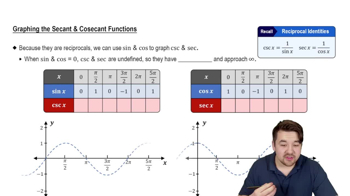
The cosecant function, denoted as csc(x), is the reciprocal of the sine function. It is defined as csc(x) = 1/sin(x). The cosecant function has vertical asymptotes where the sine function is zero, leading to undefined values. Understanding its behavior is crucial for graphing, as it influences the shape and position of the graph.
Recommended video:
6:22
Graphs of Secant and Cosecant Functions

Period of a Trigonometric Function

The period of a trigonometric function is the length of one complete cycle of the function. For the cosecant function, the standard period is 2π, but it can be altered by a coefficient in the argument. In the given function y = (1/2) csc(x/2), the period is modified to 4π due to the factor of 1/2, which affects how the graph repeats.
Recommended video:
5:33
Period of Sine and Cosine Functions

Graphing Techniques for Trigonometric Functions

Graphing trigonometric functions involves identifying key features such as amplitude, period, and asymptotes. For the cosecant function, one must first graph the sine function to determine where the cosecant will have vertical asymptotes and where it will take on values. The amplitude of the cosecant function is influenced by any coefficients in front of it, which in this case is 1/2, indicating the vertical stretch of the graph.
Recommended video:
6:04
Introduction to Trigonometric Functions