Pearson+ LogoPearson+ Logo
Ch. 2 - Graphs of the Trigonometric Functions; Inverse Trigonometric Functions
Blitzer - Trigonometry 3rd Edition
Blitzer3rd EditionTrigonometryISBN: 9780137316601Not the one you use?Change textbook
Chapter 2, Problem 94

In Exercises 83–94, use a right triangle to write each expression as an algebraic expression. Assume that x is positive and that the given inverse trigonometric function is defined for the expression in x.csc (cot⁻¹ x)

Verified step by step guidance
1
Step 1: Understand the problem. We need to express \( \csc(\cot^{-1}(x)) \) as an algebraic expression.
Step 2: Recognize that \( \cot^{-1}(x) \) is the angle whose cotangent is \( x \). This means \( \cot(\theta) = x \), where \( \theta = \cot^{-1}(x) \).
Step 3: Recall the definition of cotangent: \( \cot(\theta) = \frac{\text{adjacent}}{\text{opposite}} \). So, if \( \cot(\theta) = x \), we can consider a right triangle where the adjacent side is \( x \) and the opposite side is \( 1 \).
Step 4: Use the Pythagorean theorem to find the hypotenuse of the triangle: \( \text{hypotenuse} = \sqrt{x^2 + 1^2} = \sqrt{x^2 + 1} \).
Step 5: Recall the definition of cosecant: \( \csc(\theta) = \frac{\text{hypotenuse}}{\text{opposite}} \). Therefore, \( \csc(\cot^{-1}(x)) = \frac{\sqrt{x^2 + 1}}{1} = \sqrt{x^2 + 1} \).

Verified video answer for a similar problem:

This video solution was recommended by our tutors as helpful for the problem above.
Video duration:
3m
Was this helpful?

Key Concepts

Here are the essential concepts you must grasp in order to answer the question correctly.

Inverse Trigonometric Functions

Inverse trigonometric functions, such as cot⁻¹(x), are used to find angles when the value of a trigonometric function is known. For example, cot⁻¹(x) gives the angle whose cotangent is x. Understanding how to interpret these functions is crucial for solving problems involving right triangles.
Recommended video:
4:28
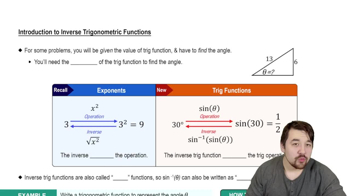
Introduction to Inverse Trig Functions

Cosecant Function

The cosecant function, denoted as csc(θ), is the reciprocal of the sine function, defined as csc(θ) = 1/sin(θ). In the context of a right triangle, it relates the length of the hypotenuse to the length of the opposite side. Recognizing how to express csc in terms of other trigonometric functions is essential for simplifying expressions.
Recommended video:
6:22
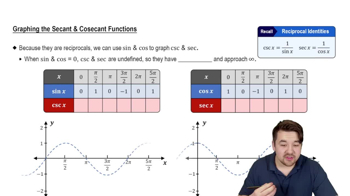
Graphs of Secant and Cosecant Functions

Right Triangle Relationships

In a right triangle, the relationships between the angles and sides are governed by trigonometric ratios. The sides are typically labeled as opposite, adjacent, and hypotenuse, which correspond to the angles. Understanding these relationships allows for the conversion of trigonometric expressions into algebraic forms, facilitating the solution of problems involving angles and side lengths.
Recommended video:
5:35
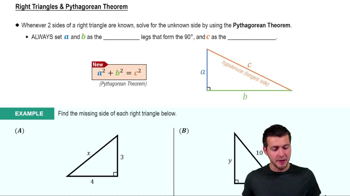
30-60-90 Triangles
Related Practice
Textbook Question
In Exercises 83–94, use a right triangle to write each expression as an algebraic expression. Assume that x is positive and that the given inverse trigonometric function is defined for the expression in x.cos (sin⁻¹ 1/x)
701
views
Textbook Question
In Exercises 83–94, use a right triangle to write each expression as an algebraic expression. Assume that x is positive and that the given inverse trigonometric function is defined for the expression in x.sec (cos⁻¹ 1/x)
586
views
Textbook Question
In Exercises 83–94, use a right triangle to write each expression as an algebraic expression. Assume that x is positive and that the given inverse trigonometric function is defined for the expression in x.___sec (sin⁻¹ x/√x²+4)
750
views
Textbook Question
The graphs of y = sin⁻¹ x, y = cos⁻¹ x, and y = tan⁻¹ x are shown in Table 2.8. In Exercises 97–106, use transformations (vertical shifts, horizontal shifts, reflections, stretching, or shrinking) of these graphs to graph each function. Then use interval notation to give the function's domain and range.f(x) = sin⁻¹ x + π/2
637
views
Textbook Question
The graphs of y = sin⁻¹ x, y = cos⁻¹ x, and y = tan⁻¹ x are shown in Table 2.8. In Exercises 97–106, use transformations (vertical shifts, horizontal shifts, reflections, stretching, or shrinking) of these graphs to graph each function. Then use interval notation to give the function's domain and range.f(x) = cos⁻¹ (x + 1)
689
views
Textbook Question
The graphs of y = sin⁻¹ x, y = cos⁻¹ x, and y = tan⁻¹ x are shown in Table 2.8. In Exercises 97–106, use transformations (vertical shifts, horizontal shifts, reflections, stretching, or shrinking) of these graphs to graph each function. Then use interval notation to give the function's domain and range.h(x) = −2 tan⁻¹ x
708
views