Pearson+ LogoPearson+ Logo
Ch. 4 - Graphs of the Circular Functions
Lial - Trigonometry 12th Edition
Lial12th EditionTrigonometryISBN: 9780136552161Not the one you use?Change textbook
Chapter 5, Problem 4.1

Fill in the blank(s) to correctly complete each sentence.
The graph of y = sin (x + π/4) is obtained by shifting the graph of y = sin x ______ unit(s) to the ________ (right/left).

Verified step by step guidance
1
Identify the transformation in the function y = \sin(x + \frac{\pi}{4}).
Recognize that the expression (x + \frac{\pi}{4}) indicates a horizontal shift.
Understand that adding \frac{\pi}{4} inside the function argument shifts the graph to the left.
Determine the magnitude of the shift, which is \frac{\pi}{4} units.
Conclude that the graph of y = \sin(x + \frac{\pi}{4}) is obtained by shifting the graph of y = \sin x \frac{\pi}{4} units to the left.

Verified video answer for a similar problem:

This video solution was recommended by our tutors as helpful for the problem above.
Was this helpful?

Key Concepts

Here are the essential concepts you must grasp in order to answer the question correctly.

Phase Shift

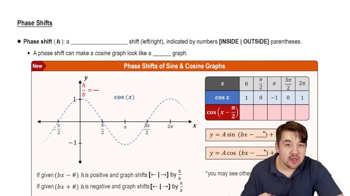
Phase shift refers to the horizontal translation of a periodic function, such as sine or cosine. In the equation y = sin(x + π/4), the term (x + π/4) indicates a shift to the left by π/4 units. This is because adding a positive value inside the function's argument results in a leftward movement on the graph.
Recommended video:
6:31
Phase Shifts

Sine Function Properties

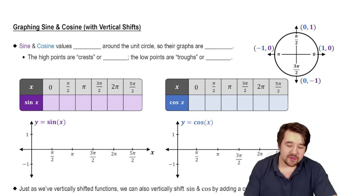
The sine function is a periodic function with a range of [-1, 1] and a period of 2π. Understanding its basic shape and behavior is crucial for analyzing transformations. The standard sine graph oscillates between -1 and 1, and any changes to its equation, such as phase shifts, affect its position but not its amplitude or period.
Recommended video:
5:53
Graph of Sine and Cosine Function

Graph Transformations

Graph transformations involve changes to the position or shape of a function's graph. These can include shifts, stretches, and reflections. In the case of y = sin(x + π/4), the transformation is a horizontal shift, which alters the starting point of the sine wave without changing its amplitude or frequency.
Recommended video:
5:25
Introduction to Transformations