
Textbook Question
Match each function with its graph in choices A–I. (One choice will not be used.)
y = sin (x - π/4)
A. <IMAGE> B. <IMAGE> C. <IMAGE>
D. <IMAGE> E. <IMAGE> F. <IMAGE>
G. <IMAGE> H. <IMAGE> I. <IMAGE>
758
views

 Verified step by step guidance
 6:04
6:04
 5:33
5:33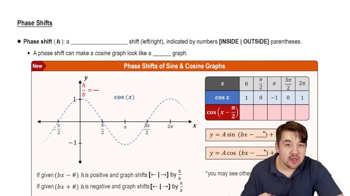 6:31
6:31Match each function with its graph in choices A–I. (One choice will not be used.)
y = sin (x - π/4)
A. <IMAGE> B. <IMAGE> C. <IMAGE>
D. <IMAGE> E. <IMAGE> F. <IMAGE>
G. <IMAGE> H. <IMAGE> I. <IMAGE>
For each function, give the amplitude, period, vertical translation, and phase shift, as applicable.
y = 2 sin 5x
Match each function with its graph in choices A–F.
y = tan (x - π )
A. <IMAGE> B. <IMAGE> C. <IMAGE>
D. <IMAGE> E. <IMAGE> F. <IMAGE>
Fill in the blank(s) to correctly complete each sentence.
The graph of y = -2 + 3 cos (x - π/6) is obtained by shifting the graph of y = cos x horizontally ________ unit(s) to the __________, (right/left) stretching it vertically by a factor of ________, and then shifting it vertically ________ unit(s) __________. (up/down)
For each function, give the amplitude, period, vertical translation, and phase shift, as applicable.
y = 3 cos (x + π/2)
For each function, give the amplitude, period, vertical translation, and phase shift, as applicable.
y = 3 - ¼ cos ⅔ x