
Ch. 6 - Inverse Circular Functions and Trigonometric Equations
Lial - Trigonometry 12th Edition
Lial12th EditionTrigonometryISBN: 9780136552161Not the one you use?Change textbook
Chapter 7, Problem 6.3.15

Answer each question.


Suppose solving a trigonometric equation for solutions over the interval [0°,360°) leads to 3θ = 180°, 630°, 720°,930°. What are the corresponding values of θ?

Verified step by step guidance
1
Identify the given equation: 3\(\theta\) equals the angles 180°, 630°, 720°, and 930°.
To find \(\theta\), divide each angle by 3, since the equation is 3\(\theta\) = angle.
Calculate \(\theta\) for each angle: \(\theta\) = \(\frac{180°}{3}\), \(\frac{630°}{3}\), \(\frac{720°}{3}\), \(\frac{930°}{3}\).
Simplify each fraction to get the values of \(\theta\).
Check that each \(\theta\) value lies within the interval [0°, 360°). If any value is outside this range, adjust it by subtracting or adding 360° as needed to bring it within the interval.

Verified video answer for a similar problem:

This video solution was recommended by our tutors as helpful for the problem above.
Was this helpful?

Key Concepts

Here are the essential concepts you must grasp in order to answer the question correctly.

Solving Trigonometric Equations

Solving trigonometric equations involves finding all angle values that satisfy the given equation within a specified interval. This often requires isolating the variable and considering the periodic nature of trigonometric functions to identify multiple solutions.
Recommended video:
4:34
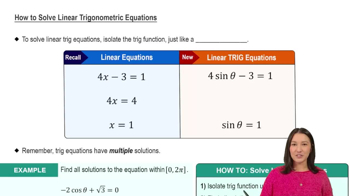
How to Solve Linear Trigonometric Equations

Angle Division and Interval Constraints

When an equation involves a multiple of an angle, such as 3θ, dividing the solutions by that multiple gives the values of θ. It is important to adjust the solutions to fit within the original interval, here [0°, 360°), by considering the periodicity and reducing angles modulo 360° if necessary.
Recommended video:
04:46
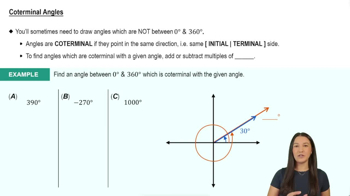
Coterminal Angles

Understanding Angle Measures and Periodicity

Angles in trigonometry are often measured in degrees and repeat every 360°. Recognizing that angles differing by full rotations (multiples of 360°) represent the same position on the unit circle helps in identifying equivalent solutions and restricting answers to the given interval.
Recommended video:
5:33
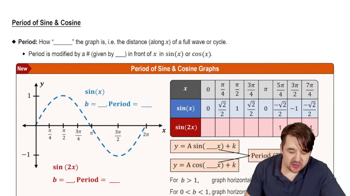
Period of Sine and Cosine Functions