Pearson+ LogoPearson+ Logo
Ch. 7 - Applications of Trigonometry and Vectors
Lial - Trigonometry 12th Edition
Lial12th EditionTrigonometryISBN: 9780136552161Not the one you use?Change textbook
Chapter 8, Problem 7.23

Use the parallelogram rule to find the magnitude of the resultant force for the two forces shown in each figure. Round answers to the nearest tenth.
<IMAGE>

Verified step by step guidance
1
Identify the magnitudes and directions of the two forces given in the problem.
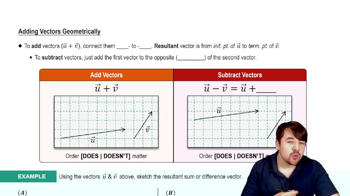
Use the parallelogram rule, which involves placing the two vectors such that they start from the same point, and then completing the parallelogram.
Calculate the angle between the two vectors if not given, using any additional information provided in the problem.
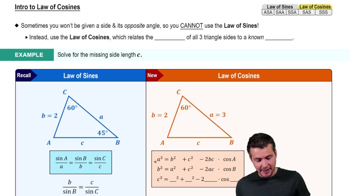
Apply the law of cosines to find the magnitude of the resultant vector: \( R = \sqrt{A^2 + B^2 + 2AB \cos(\theta)} \), where \( A \) and \( B \) are the magnitudes of the two forces, and \( \theta \) is the angle between them.
Round the magnitude of the resultant force to the nearest tenth as instructed.

Verified video answer for a similar problem:

This video solution was recommended by our tutors as helpful for the problem above.
Was this helpful?

Key Concepts

Here are the essential concepts you must grasp in order to answer the question correctly.

Parallelogram Rule

The parallelogram rule is a method used to determine the resultant vector when two vectors are acting simultaneously. It states that if two vectors are represented as two adjacent sides of a parallelogram, the diagonal of the parallelogram represents the resultant vector in both magnitude and direction. This rule is particularly useful in physics and engineering for analyzing forces and motion.
Recommended video:
5:08
Sine, Cosine, & Tangent of 30°, 45°, & 60°

Vector Magnitude

The magnitude of a vector is a measure of its length or size, often represented as a non-negative number. In the context of forces, the magnitude indicates the strength of the force being applied. To calculate the magnitude of a resultant vector, one typically uses the Pythagorean theorem when the vectors are perpendicular, or other trigonometric methods when they are not.
Recommended video:
04:44
Finding Magnitude of a Vector

Rounding Numbers

Rounding numbers is the process of adjusting a number to a specified degree of accuracy, often to simplify calculations or present results clearly. In this context, rounding to the nearest tenth means adjusting the resultant force's magnitude to one decimal place. This is important for reporting results in a standardized format, making them easier to interpret and compare.
Recommended video:
3:31
Introduction to Complex Numbers