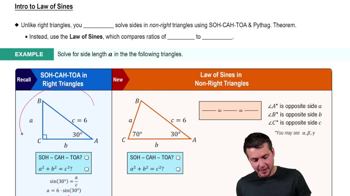
First, find the measure of angle B using the fact that the sum of the angles in any triangle is 180°. Use the formula: \(B = 180^\circ - A - C\).
Next, use the Law of Sines to find the lengths of sides a and c. The Law of Sines states: \(\frac{a}{\sin A} = \frac{b}{\sin B} = \frac{c}{\sin C}\).
Calculate side a by rearranging the Law of Sines: \(a = b \times \frac{\sin A}{\sin B}\).
Calculate side c similarly: \(c = b \times \frac{\sin C}{\sin B}\).
After finding all sides and angles, verify your answers by checking that the triangle's sides and angles satisfy the triangle inequality and angle sum properties.
Verified video answer for a similar problem:
This video solution was recommended by our tutors as helpful for the problem above
Play a video:
0 Comments
Key Concepts
Here are the essential concepts you must grasp in order to answer the question correctly.
Triangle Angle Sum Theorem
This theorem states that the sum of the interior angles in any triangle is always 180°. Knowing two angles allows you to find the third by subtracting their sum from 180°, which is essential for solving the triangle.
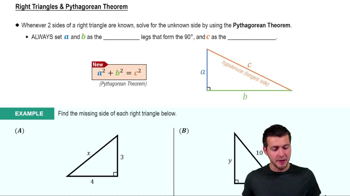
Solving Right Triangles with the Pythagorean Theorem
Law of Sines
The Law of Sines relates the ratios of the lengths of sides of a triangle to the sines of their opposite angles. It is expressed as (a/sin A) = (b/sin B) = (c/sin C), and is used to find unknown sides or angles when given partial information.
Solving a triangle means finding all unknown sides and angles using given data. This often involves applying the Triangle Angle Sum Theorem and the Law of Sines or Cosines, depending on the known elements, to fully determine the triangle's dimensions.