Pearson+ LogoPearson+ Logo
Ch. 7 - Applications of Trigonometry and Vectors
Lial - Trigonometry 12th Edition
Lial12th EditionTrigonometryISBN: 9780136552161Not the one you use?Change textbook
Chapter 8, Problem 7.1

Which one of the following sets of data does not determine a unique triangle?
a. A = 50°, b = 21, a = 19
b. A = 45°, b = 10, a = 12
c. A = 130°, b = 4, a = 7
d. A = 30°, b = 8, a = 4

Verified step by step guidance
1
Identify the given data for each option: angle A and sides a and b.
Recall the Law of Sines: \( \frac{a}{\sin A} = \frac{b}{\sin B} = \frac{c}{\sin C} \).
Determine if the given data can form a unique triangle by checking if the angle-side-side (ASS) condition leads to an ambiguous case.
For each option, calculate the possible values of angle B using the Law of Sines and check if more than one triangle can be formed.
Identify the option where the ASS condition leads to two possible triangles, indicating that it does not determine a unique triangle.

Verified video answer for a similar problem:

This video solution was recommended by our tutors as helpful for the problem above.
Was this helpful?

Key Concepts

Here are the essential concepts you must grasp in order to answer the question correctly.

Triangle Congruence Criteria

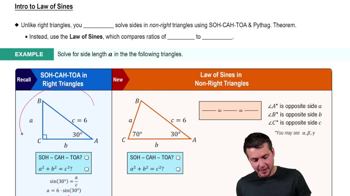
Triangle congruence criteria are rules that determine when two triangles are congruent, meaning they have the same size and shape. The most common criteria include Side-Angle-Side (SAS), Angle-Side-Angle (ASA), and Side-Side-Side (SSS). Understanding these criteria helps in identifying whether a given set of measurements can form a unique triangle.
Recommended video:
5:35
30-60-90 Triangles

Ambiguous Case of the Law of Sines

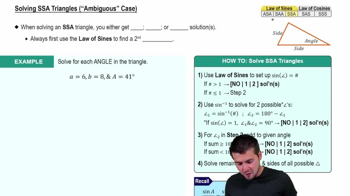
The ambiguous case occurs when using the Law of Sines to solve for a triangle with two sides and a non-included angle (SSA). This situation can lead to zero, one, or two possible triangles, depending on the specific values of the sides and angle. Recognizing this case is crucial for determining whether a unique triangle can be formed.
Recommended video:
9:50
Solving SSA Triangles ("Ambiguous" Case)

Sum of Angles in a Triangle

The sum of the interior angles in any triangle is always 180 degrees. This fundamental property is essential for verifying the validity of angle measures provided in triangle problems. If the angles do not sum to 180 degrees, the given data cannot form a triangle, which is a key consideration in the question.
Recommended video:
4:47
Sum and Difference of Tangent