Pearson+ LogoPearson+ Logo
Ch. 8 - Complex Numbers, Polar Equations, and Parametric Equations
Lial - Trigonometry 12th Edition
Lial12th EditionTrigonometryISBN: 9780136552161Not the one you use?Change textbook
Chapter 9, Problem 13c

For each pair of polar coordinates, (c) give the rectangular coordinates for the point. See Examples 1 and 2(a).


(1 , 45°)

Verified step by step guidance
1
Step 1: Understand that polar coordinates are given in the form \((r, \theta)\), where \(r\) is the radius (distance from the origin) and \(\theta\) is the angle in degrees or radians from the positive x-axis.
Step 2: Convert the angle from degrees to radians if necessary. In this case, the angle is already given in degrees as 45°.
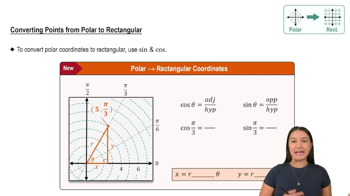
Step 3: Use the conversion formulas to find the rectangular coordinates \((x, y)\). The formulas are: \(x = r \cdot \cos(\theta)\) and \(y = r \cdot \sin(\theta)\).
Step 4: Substitute the given values into the formulas. Here, \(r = 1\) and \(\theta = 45°\). Calculate \(x = 1 \cdot \cos(45°)\) and \(y = 1 \cdot \sin(45°)\).
Step 5: Use the known trigonometric values: \(\cos(45°) = \sin(45°) = \frac{\sqrt{2}}{2}\). Substitute these values to find \(x\) and \(y\).

Verified video answer for a similar problem:

This video solution was recommended by our tutors as helpful for the problem above.
Video duration:
2m
Was this helpful?

Key Concepts

Here are the essential concepts you must grasp in order to answer the question correctly.

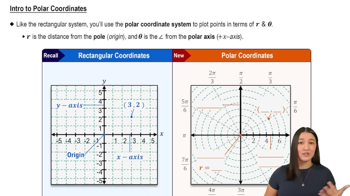
Polar Coordinates

Polar coordinates represent a point in a plane using a distance from a reference point (the origin) and an angle from a reference direction (usually the positive x-axis). The format is (r, θ), where 'r' is the radial distance and 'θ' is the angle in degrees or radians. Understanding this system is crucial for converting to rectangular coordinates.
Recommended video:
05:32
Intro to Polar Coordinates

Rectangular Coordinates

Rectangular coordinates, also known as Cartesian coordinates, express a point in a plane using two perpendicular axes, typically labeled x and y. The coordinates are given in the form (x, y). The conversion from polar to rectangular coordinates involves using the formulas x = r * cos(θ) and y = r * sin(θ).
Recommended video:
06:17
Convert Points from Polar to Rectangular

Trigonometric Functions

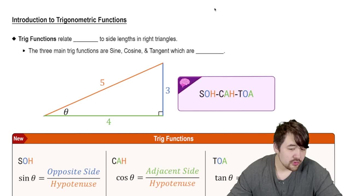
Trigonometric functions, such as sine and cosine, are fundamental in relating angles to the ratios of sides in right triangles. In the context of polar to rectangular conversion, these functions are used to determine the x and y coordinates based on the angle θ. Mastery of these functions is essential for accurately performing the conversion.
Recommended video:
6:04
Introduction to Trigonometric Functions