
Ch. R - Algebra Review
Lial - Trigonometry 12th Edition
Lial12th EditionTrigonometryISBN: 9780136552161, 9780135440780, 9780136881117, 9780135440827, 9780135924891Not the one you use?Change textbook
Chapter 1, Problem 149

For Individual or Group Work (Exercises 147 – 150)In calculus, it is sometimes desirable to rationalize a numerator. To do this, we multiply the numerator and the denominator by the conjugate of the numerator. For example, (6 - √2)/4 = (6 - √2)/4 × (6 + √2)/(6 + √2) = (36 - 2)/(4(6 + √2)) = 34/(4(6 + √2)) = 17/(2(6 + √2)) = 17/(6 + √2).
2√10 + √7 30

Verified step by step guidance
1
Identify the expression to rationalize: the numerator is \(2\sqrt{10} + \sqrt{7}\) and the denominator is 30.
To rationalize the numerator, multiply both the numerator and the denominator by the conjugate of the numerator. The conjugate of \(2\sqrt{10} + \sqrt{7}\) is \(2\sqrt{10} - \sqrt{7}\).
Set up the multiplication: multiply numerator and denominator by \(2\sqrt{10} - \sqrt{7}\), so the expression becomes \(\frac{(2\sqrt{10} + \sqrt{7})(2\sqrt{10} - \sqrt{7})}{30(2\sqrt{10} - \sqrt{7})}\).
Use the difference of squares formula for the numerator: \((a + b)(a - b) = a^2 - b^2\). Here, \(a = 2\sqrt{10}\) and \(b = \sqrt{7}\), so calculate \(a^2 - b^2\).
Simplify the numerator by squaring each term: \(a^2 = (2\sqrt{10})^2\) and \(b^2 = (\sqrt{7})^2\), then subtract to get the rationalized numerator. The denominator remains as \(30(2\sqrt{10} - \sqrt{7})\).

Verified video answer for a similar problem:

This video solution was recommended by our tutors as helpful for the problem above.
Video duration:
6m

Key Concepts

Here are the essential concepts you must grasp in order to answer the question correctly.

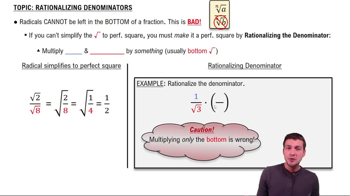
Rationalizing the Numerator

Rationalizing the numerator involves eliminating radicals from the numerator of a fraction by multiplying both numerator and denominator by a suitable expression, often the conjugate. This process simplifies expressions and makes them easier to work with, especially in calculus and algebra.
Recommended video:
Guided course
2:58
Rationalizing Denominators

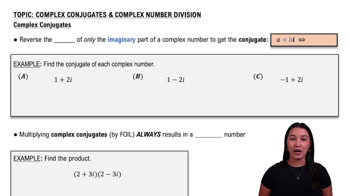
Conjugates in Algebra

The conjugate of a binomial expression a + b√c is a - b√c, and vice versa. Multiplying an expression by its conjugate uses the difference of squares formula, which removes the square root terms, resulting in a rational number or simpler expression.
Recommended video:
5:33
Complex Conjugates

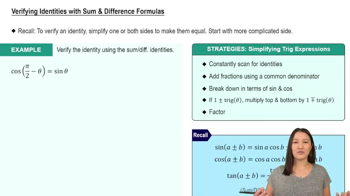
Difference of Squares Formula

The difference of squares formula states that (x + y)(x - y) = x² - y². This identity is crucial when multiplying conjugates because it eliminates radicals by turning the product into the difference of two squares, simplifying expressions with square roots.
Recommended video:
2:25
Verifying Identities with Sum and Difference Formulas