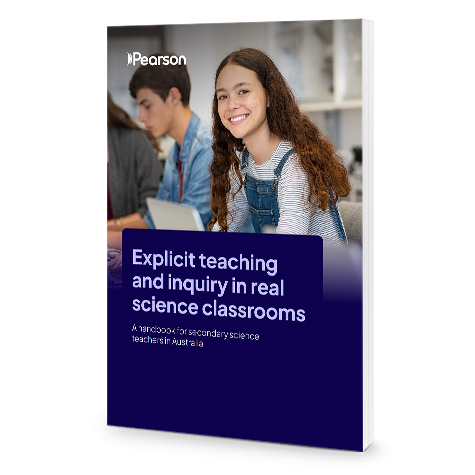
-
Explore how explicit teaching and inquiry can work together to improve student outcomes.
-
Understand how and when both approaches can be used with an example progression.
-
Apply to your class, guided by recommendations and a 'thinking scientifically' checklist.
Where does inquiry fit with explicit teaching?
As explicit teaching returns to focus in Australian schools, science teachers are asking an important question: what does this mean for inquiry, experimentation and practical learning?
This handbook breaks down research, connecting it to real science classrooms with a practical example, as well as recommendations and a checklist to help integrate these approaches effectively and consistently.
Download the handbook
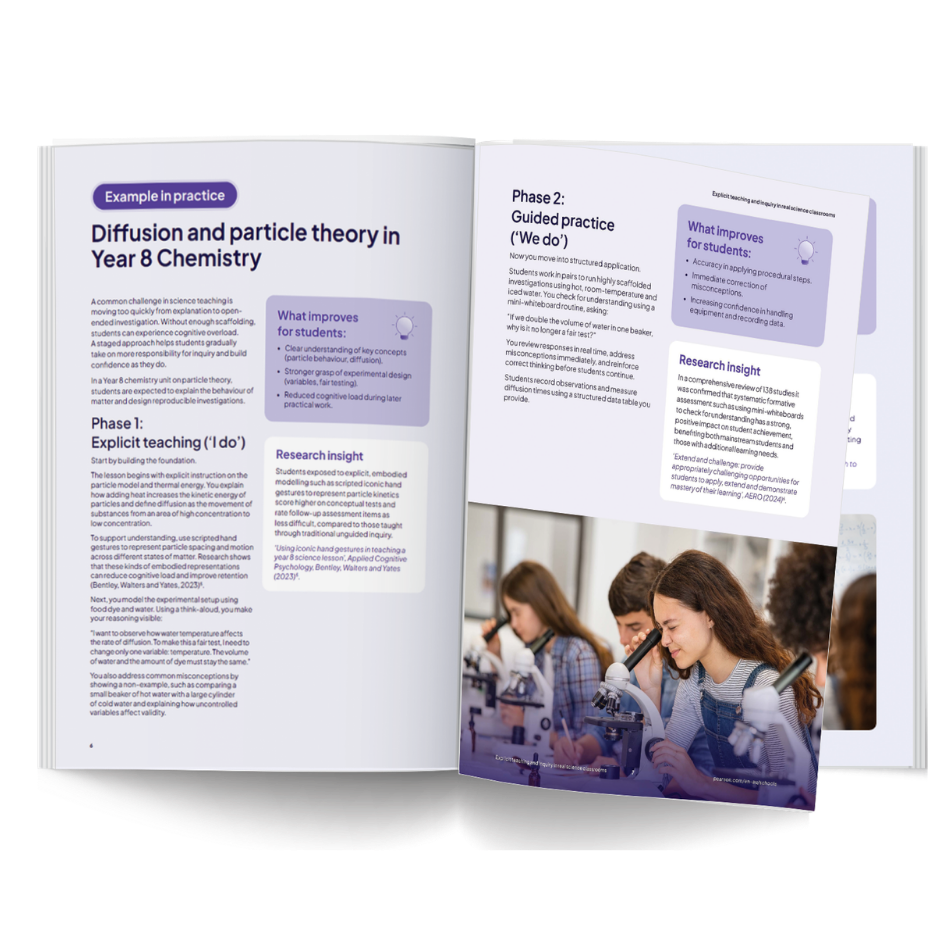
Example in practice: Diffusion and particle theory in Year 8 Chemistry
The handbook includes a research-informed example outlining how teachers can sequence explicit teaching with inquiry to reduce cognitive overload and help students build confidence and independence.
Using a Year 8 Chemistry example, you’ll see how modelling, questioning, scaffolding and gradual release can support students to design fair tests, analyse results and reason with evidence.
Download the handbookDownload the handbook
Complete the form to get instant access to the research-informed, practical handbook.