Grammar 101: insider tips and tricks to instantly improve your writing (part 2)

Hannah Lawrence
Hannah Lawrence
A professional man sits at a desk, writing notes with a laptop open in front of him.
Reading time: 5 minutes

As a proofreader and editor, I'm often asked to explain the rules of grammar. I answered three of the most common questions in the first post of this series, and now it's time to look at another frequent query: how to use apostrophes. Where do they go? When are they needed? And when should they be left out entirely?

Apostrophes might be small but they can cause big confusion because they are used both to indicate posession and to contract words. But the good news is that there are clear, simple patterns to follow, which we'll explore, along with exceptions to watch out for. Whether you’re writing a report or just a text message, these tips will help you use apostrophes correctly and confidently.

Apostrophes with ease: posession

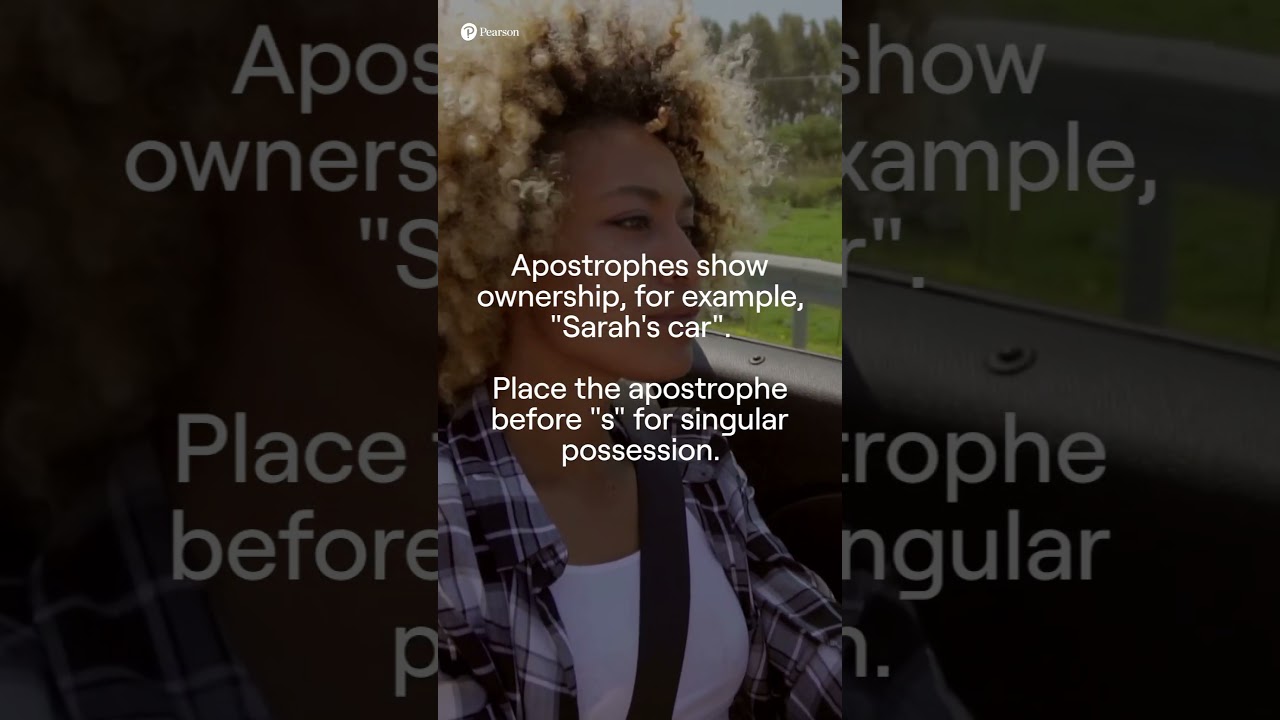
Apostrophes show possession: they tell us something belongs to someone or something. When we want to show possession for regular plurals (when a word needs an "s" to make it plural), the apostrophe goes at the end and no further "s" is added: 

  • The teachers' association
  • The campaigners' letter
  • The dogs' dinner

Whereas, when we want to show posession for either a single noun or an irregular plural (for example, children, geese), we add an "apostrophe s":

  • Sarah's car
  • Pearson's assessment tools
  • The children's presents
  • The geese's pond

Single names that end in an “s” get an “apostrophe s” but plural names get only an apostrophe:

  • Mrs Jones’s car
  • James's cat
  • Whole Foods’ offices
  • Starbucks' nearest store

There's one exception that's important to note: "its" and "it's". The posessive form "its" does not have an apostrophe: "it's" always means "it is". 

  • The cat ate its food

Apostrophes with ease: contractions

Contracted words are the combined and shortened forms of two words, which are commonly used in everyday writing and speech to sound more natural and conversational. They're made by omitting certain letters and replacing them with an apostrophe: for example, in "don't", it replaces the missing “o” from not. 

When you miss one or more letters, use an apostrophe:

  • "would not" becomes "wouldn’t"
  • "cannot" becomes "can’t"
  • "we are" becomes "we're"
  • and, as before, "it is" becomes "it's"

When not to use apostrophes

A common mistake is using apostrophes when making words plural or when refering to decades and numbers. For example:

  • The 1980s had the best music (not "The 1980's")
  • Many people retire from working in their 70s (not "their 70's")
  • I bought some apples at the store (not "apple's")
Using apostrophes: simple tips to improve your writing skills
Play
Privacy and cookies

By watching, you agree Pearson can share your viewership data for marketing and analytics for one year, revocable by deleting your cookies.

Test your knowledge

Now you know the basic rules of apostrophes, it's time to check your knowledge.

Which sentence is correct?:

  1. The childrens break time has finished
  2. The childrens' break time has finished
  3. The children's break time has finished

It's sentence 3. We want to show posession – break time belongs to the children – and "children" is plural so it gets an "apostrophe s".
Now try these sentences and see if you can figure out which one is right:

  1. When you're walking my dog, its important to remember it's collar.
  2. When you're walking my dog, it's important to remember its collar.
  3. When youre walking my dog, it's important to remember it's collar.

The correct answer is 2. "You're" is a contraction of "you are", "it is important" so we use "it's" and we show that the collar belongs to the dog by using "its". Finally: 

  1. Luis' daughter won't go to sleep. 
  2. Luis's daughter wont go to sleep. 
  3. Luis's daughter won't go to sleep. 

Here, the right answer is 3. "Luis" is a single name, so gets an "apostrophe s", and "will not" is shortened to "won't". 

Hopefully you now feel more confident in using apostrophes in your writing. Look out for the next post in this series, where we’ll explore more common grammar mistakes and how to avoid them.

More blogs from Pearson

  • Two business professionals loooking at notes together
    GSE, KPIs and ROI (Part 2): Turning language data into business value
    By Łukasz Pakuła
    Reading time: 5 minutes

    In Part 1, we looked at how to build a sensible measurement philosophy for language training using KPIs and the Global Scale of English (GSE). We’ve established that language programs shouldn’t be treated as a calendar entry, but as a strategic lever, and that independence, granularity and credibility are the secret sauce.

    Now it’s time to move from how to why: how these datapoints translate into tangible business outcomes, and how to make sure your investment in English doesn’t just look good on slides but actually delivers value when the CFO walks in.

    From measuring to meaning: translating KPIs into ROI

    Let’s be blunt: only a reckless stakeholder invests without expecting a return. Weighing costs and benefits, however, can get tricky. Without some operational clarity, ROI quickly becomes either a fairy tale or a labyrinth, both of which are bad news in risk-averse corporate cultures.

    From a client’s perspective, it’s vital to include all components in your calculation: direct delivery fees, platform access, materials and, ideally, a provider capable of offering the full package. And please don’t forget the indirect cost of time. Two hours of lessons per week equals more than 100 hours per learner per year. Add the asynchronous learning that every serious learner contributes, and we’re suddenly talking about real numbers.

    If you skip that, the ROI will look spectacular on paper until someone performs a reality check and the budget line gets a little uncomfortable. If you’re an L&D manager reading this, add sensible estimates for coordination and reporting. Ideally, your provider helps you keep those to a minimum. At choices®, which provides language services, we see this as part of the service rather than a side quest. Trust me, it saves everyone time and sanity.

  • Students looking at notebooks smiling
    Get same-day results with Pearson English Express Test
    By Abi Fordham
    Reading time: 2 minutes

    If you’ve ever taken an English test and found yourself constantly checking your inbox, wondering when your score will arrive, you’re not alone. I worked across Pearson’s social media channels for years, and I heard from students every day who were anxious to know how they did, despite it only being an hour into the standard 48-hour turnaround time.

    That’s why I’m so excited about the Pearson English Express Test - because it gives you something most tests don’t: a score in minutes.

    The score that helps you plan

    Let’s talk about the unofficial score. You’ll see it just minutes after finishing the test. While it’s not certified for university applications just yet, it’s a powerful tool for planning your next move.

    If your score is where you hoped it would be, you can start preparing your application materials with confidence. If it’s not quite there, you’ve got a head start on knowing what to improve, and you haven’t lost time waiting to find out. It’s like getting a sneak peek at your future, and it’s one of the most empowering parts of the Pearson English Express Test experience.

    Fast and reliable certified results

    Of course, you’ll still need your certified score to apply to universities. That’s delivered within 48 hours, after a security review.

    • AI scoring ensures fairness and consistency.
    • Remote proctoring and ID checks keep the process secure.
    • Certified results align with CEFR standards and are trusted by institutions.

    You get speed and reliability – without compromise.

    Why fast English test results matter for students

    When you’re applying to study in the USA, every day counts and you’ll have so many things to tick off your list. You might be juggling deadlines, coordinating with universities, or planning your next big move. The Pearson English Express Test was built to support you, not slow you down.

    It’s fast, fair and designed for students who want to move forward with confidence.

    Ready to take the Pearson English Express Test?

    If you’re looking for a test that gives you answers quickly and helps you plan your next step, this is it.

    Take your test today and experience the difference for yourself.

  • A student and lecturer talking together in a lecture room
    Language education trend predicitions for 2026
    By Charlotte Guest
    Reading time: 4 minutes

    Language education has never been more active or challenging. We've experienced significant changes in technology, changing student needs and higher expectations for practical results. Looking ahead to 2026, the outlook is positive: better tools, clearer skill guides and learning that feels more personal and human.

    Below are nine trends to keep an eye on in 2026 for your language teaching. 

    AI becomes your co-teacher, not your replacement

    Generative AI is moving from novelty to dependable support: drafting lesson variants, generating levelled texts, offering initial feedback on writing and speaking, and freeing you to focus on pedagogy and relationships. The emphasis in 2026 is on ethical, transparent use: you set the learning goals and the guardrails; AI accelerates the workflow.

    Try: Use AI to produce three versions of a reading at different proficiency bands, then validate levels using a recognized framework.

    Data-informed personalization with clear proficiency frameworks

    Teachers want data they can trust and act on. Proficiency frameworks like the Global Scale of English (GSE) make progress visible and instructional decisions simpler, connecting learning objectives, materials and assessments across skills and levels. Expect more “micro-mastery” milestones and dashboards that turn evidence into next-step teaching.

    Try: Map unit outcomes to specific "can-do" statements, then build short practice cycles around those micro-goals. Use GSE-aligned resources to set targets and monitor growth.