Ch. 3 - Derivatives
Briggs - Calculus: Early Transcendentals 3rd Edition
Briggs3rd EditionCalculus: Early TranscendentalsISBN: 9780136847243Not the one you use?Change textbook
Chapter 3, Problem 58

Calculate the derivative of the following functions.
y = (1 - e0.05x)-1

Verified step by step guidance
1
Step 1: Identify the function y = (1 - e^{0.05x})^{-1} as a composition of functions, where the outer function is u^{-1} and the inner function is u = 1 - e^{0.05x}.
Step 2: Apply the chain rule for differentiation, which states that the derivative of a composite function y = f(g(x)) is given by y' = f'(g(x)) * g'(x).
Step 3: Differentiate the outer function u^{-1} with respect to u, which gives -u^{-2}.
Step 4: Differentiate the inner function u = 1 - e^{0.05x} with respect to x, which gives -0.05e^{0.05x}.
Step 5: Combine the results from Steps 3 and 4 using the chain rule: y' = -u^{-2} * (-0.05e^{0.05x}), and substitute u = 1 - e^{0.05x} back into the expression.

Verified video answer for a similar problem:

This video solution was recommended by our tutors as helpful for the problem above.
Video duration:
5m
Was this helpful?

Key Concepts

Here are the essential concepts you must grasp in order to answer the question correctly.

Derivative

The derivative of a function measures how the function's output value changes as its input value changes. It is a fundamental concept in calculus that provides the slope of the tangent line to the curve at any given point. The derivative can be computed using various rules, such as the power rule, product rule, quotient rule, and chain rule, depending on the form of the function.
Recommended video:
05:44
Derivatives

Chain Rule

The chain rule is a formula for computing the derivative of the composition of two or more functions. It states that if you have a function y = f(g(x)), the derivative dy/dx can be found by multiplying the derivative of the outer function f with respect to g by the derivative of the inner function g with respect to x. This rule is essential when differentiating functions that are nested within each other.
Recommended video:
05:02
Intro to the Chain Rule

Exponential Functions

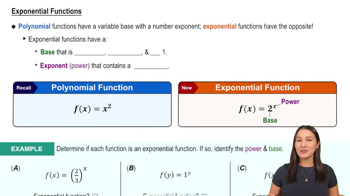
Exponential functions are mathematical functions of the form y = a * e^(bx), where e is the base of the natural logarithm, and a and b are constants. These functions are characterized by their rapid growth or decay and are commonly encountered in calculus. The derivative of an exponential function is unique in that it is proportional to the function itself, making it crucial for solving problems involving growth rates.
Recommended video:
6:13
Exponential Functions
Related Practice
Textbook Question

Determining the unknown constant Let f(x) = {2x² if x≤1 ax-2 if x>1. Determine a value of a (if possible) for which f' is continuous at x=1.

332
views

Textbook Question

The energy (in joules) released by an earthquake of magnitude M is given by the equation E = 25,000 ⋅ 101.5M. (This equation can be solved for M to define the magnitude of a given earthquake; it is a refinement of the original Richter scale created by Charles Richter in 1935.)

Compute the energy released by earthquakes of magnitude 1, 2, 3, 4, and 5. Plot the points on a graph and join them with a smooth curve.

482
views
Textbook Question

Find and simplify the derivative of the following functions.

h(x) = (5x7 + 5x)(6x3 + 3x2 + 3)

315
views
Textbook Question

{Use of Tech} Equations of tangent lines

Find an equation of the line tangent to the given curve at a.

y = −3x2 + 2; a=1

381
views
Textbook Question

Power and energy are often used interchangeably, but they are quite different. Energy is what makes matter move or heat up. It is measured in units of joules or Calories, where 1 Cal=4184 J. One hour of walking consumes roughly 10⁶J, or 240 Cal. On the other hand, power is the rate at which energy is used, which is measured in watts, where 1 W = 1 J/s. Other useful units of power are kilowatts (1 kW=10³ W) and megawatts (1 MW=10⁶ W). If energy is used at a rate of 1 kW for one hour, the total amount of energy used is 1 kilowatt-hour (1 kWh = 3.6×10⁶ J) Suppose the cumulative energy used in a large building over a 24-hr period is given by E(t)=100t + 4t² − (t³ / 9) kWh where t = 0 corresponds to midnight.

The power is the rate of energy consumption; that is, P(t) = E′(t) Find the power over the interval 0 ≤ t ≤ 24.

452
views
Textbook Question

{Use of Tech} Equations of tangent lines

b. Use a graphing utility to graph the curve and the tangent line on the same set of axes.

y = −3x²+2; a=1

401
views